



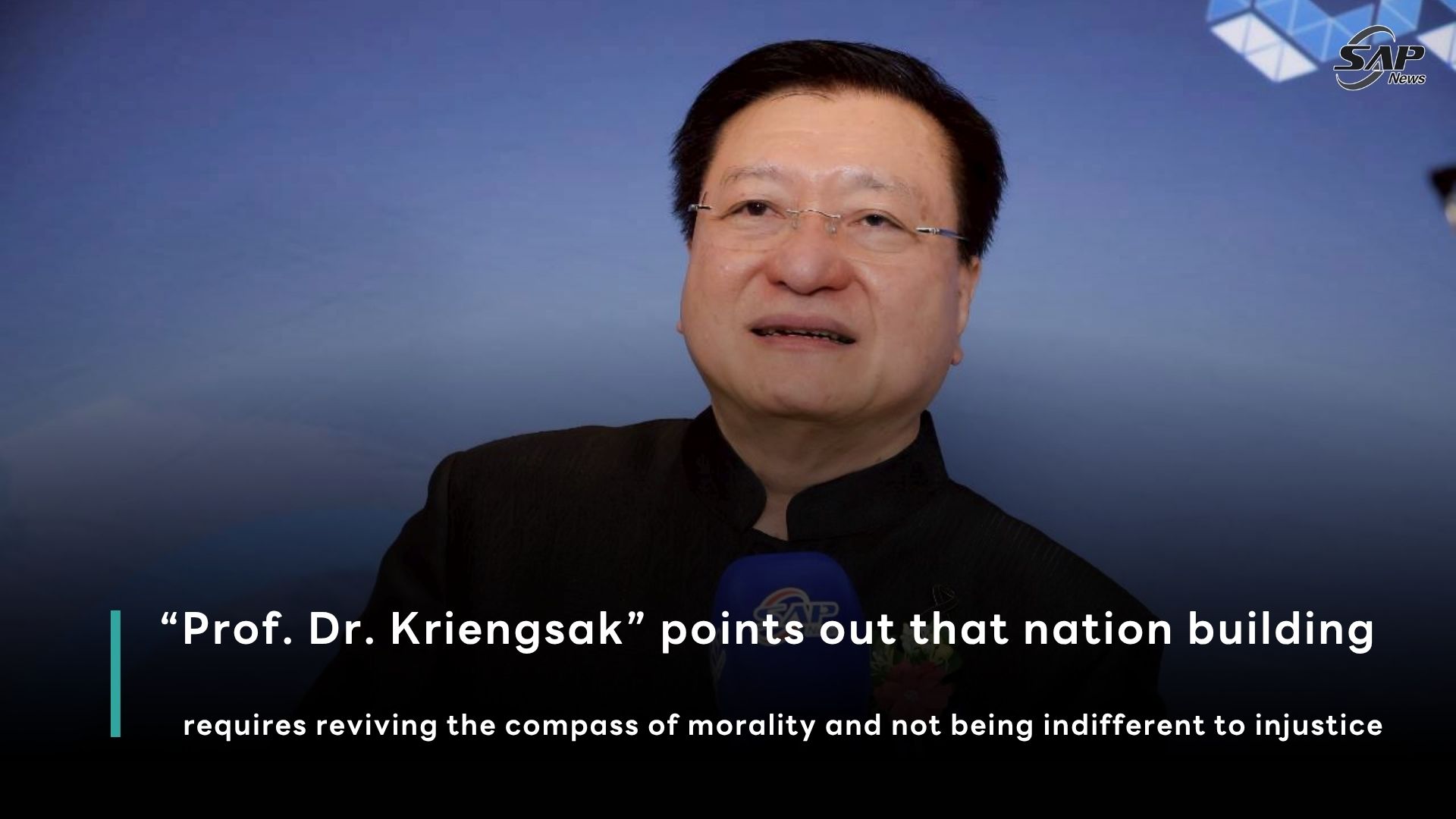
"Prof. Dr. Kriengsak" points out that nation building requires reviving the compass of morality and not being indifferent to injustice
On June 17, 2026, at 8:30 AM, at the Institute for Nation Building, Thailand, reporters covered the 2026 International Conference on Nation Building for Well-being and Peace Based on Morality: “Nation Building for Well-being and Peace in a World of Moral Ambiguity,” organized by the Nation-Building International Institute, the Institute for Nation Building Thailand, the Institute for Nation Building Malaysia, the Institute for Future Studies for Development, the Institute of International Relations, the Social Science Association of Thailand, the South Asian Future Forecast Institute (USA), and the International Exchange Development Federation (Republic of Korea).
Deputy Prime Minister Pakorn Nilapraphan sent a congratulatory message on the 10th International Conference, stating that the conference was held at a critical time when the world was facing rapid change. Due to technological advancements, international connectivity, and increasingly complex challenges, addressing these situations requires not only effective policies but also responsible leadership and cooperation from all sectors, both nationally and internationally. This collaborative effort aims to build a strong, balanced, resilient nation and society, leading to lasting peace based on morality.
Associate Professor Dr. Phokin Pholkul, Thailand's 79th Deputy Prime Minister, stated that one of the key factors eroding national strength is “moral ambiguity” within society itself. Nation-building in this context therefore requires six fundamental foundations: 1. Moral leadership at all levels; 2. Institutions and organizations prioritizing truth and righteousness over immediate self-interest; 3. Education that instills morality and courage in making decisions in difficult situations; 4. A culture of trust where leaders and citizens value each other; 5. Shared responsibility in nation-building at the community, national, and global levels; and 6. Raising awareness and creating spaces for exchange so that society can clearly distinguish between right and wrong during times when morality is tested.

Meanwhile, Professor Dr. Kriengsak Chareonwongsak, President of the Nation-Building International Institute (NBII), delivered a keynote address on the topic of “Nation-Building in a World of Blurred Morality,” emphasizing that we are living in a time when corruption is normalized under the guise of tangible results, and environmental destruction is hailed as progress. This constitutes a “crisis of moral direction” facing all nations worldwide. Moral blurring doesn't mean a lack of ethics or morality, but rather a state where moral reference points are fragmented, each party having its own moral framework, while society lacks a common compass. Universal truth is weakened by extreme relativism, and moral clarity is replaced by moral confusion.
“This crisis cannot be solved by moral authoritarianism that forces everyone to think alike, nor can we allow society to drift towards ‘directionless relativism’ where all moral claims are considered equal. The solution is a nation-building approach that is genuinely moral, not coercive, embraces diversity without being directionless, tolerates differences without being indifferent to injustice, and keeps pace with the times without being spiritually empty,” Prof. Dr. Kriengsak said.
Prof. Dr. Kriengsak further stated that, therefore, to build the nation in a global context, he proposes three important missions: 1. Restoring truth as a public asset, because no nation can be built on lies. Truth is not merely personal morality, but a fundamental structure of public life. Society must protect institutions, agencies, or organizations that seek the truth, academic freedom, transparent information, ethical media, and public spaces where citizens can scrutinize, correct, and learn together. 2. Building an ethics of responsibility, because if the language of morality has no practical effect, the words “justice,” “honesty,” and “dignity” will be nothing more than rhetoric. Responsibility must arise at the individual, institutional, and national levels. Citizens should not only ask, “What freedom do I have?” but also, “Who is affected by my actions?” While institutions must use fair and transparent rules, punish corruption, and consider public office as trust, not private property. And 3. Investing in education based on morality, meaning not through rote indoctrination, but cultivating human beings who are able to discern moral truth. Education based on morality must cultivate three competencies: moral reasoning, moral empathy, and moral courage.

Prof. Dr. Kriengsak further stated that he proposes the application of the “Universal Dhamma” framework, which is not a narrow religious doctrine but a shared moral horizon for humanity. This framework comprises 10 moral principles: humanism, humanism, liberalism, equal rights and duties, justice, fraternity, unity, peace, forgiveness, and environmentalism, to drive social change and focus on unified nation-building. Simultaneously, a proposal was made to initiate the Global Moral Formation Initiative, with Thailand leading the way through the development of citizens' moral and ethical knowledge, leadership training, cross-cultural dialogue, and youth development based on universal moral principles.
“When a nation rediscovers its moral compass, it rediscovers its future. This is the most important mission of nation-building in our time,” said Prof. Dr. Kriengsak.
Following this was a roundtable discussion with world leaders including Prof. Dr. Kriengsak Chareonwongsak, President of the International Institute for Nation-Building; Mr. Masaharu Nakagawa, former Minister of Education, Culture, Sports, Science and Technology of Japan; Dr. Narongchai Akrasanee, former Minister of Commerce and former Minister of Energy; Mr. Korn Thapparangsi, former 64th Deputy Prime Minister of Thailand; Mr. Jae Jin Han, Executive Director of the Asian Water Council, Republic of Korea; Mr. Simon Moran, President of the Australian-Thai Chamber of Commerce; Mr. Ravi Sawney, former senior official of the United Nations Economic and Social Commission for Asia and the Pacific (UN ESCAP) and Chairman of the Board of Directors of Labassa Holdings Limited; and Assoc. Prof. Dr. Suriyadev Tripathi, Director of the Thailand Moral Development Center (Public Organization). The discussion was moderated by Dr. Don Nakornthap, Assistant Governor, Monetary Policy Department, Bank of Thailand. The global leaders participated in a forum to seek solutions for humanity on how to maintain social stability, national unity, and world peace.
However, the 10th International Conference on Nation Building, Well-being, and Peace in a World of Moral Ambiguity was honored by the participation of leaders, academics, policymakers, and experts from over 30 countries worldwide. They exchanged views and policy proposals on nation-building, well-being, and peace amidst the challenges of the modern world. Over 500 people attended the physical conference, and over 3,000 participated online, representing a significant international intellectual gathering.
Photo : Yanawut Samphaothong
Copywriter: Siam Associated Press (SAP) Editorial Department
Pictures: Some illustrations come from the Internet. If there is any infringement, please contact us to delete it.
Source of material: official media /online news
273/3 Ratchadaphisek Rd., Ratchadaphisek, Din Daeng, Bangkok, 10400
Email reporter@sapnewsth.com
Tel. 099 569 5964