



“Minister of Defense” presides over presentation of NDC class 68 study findings
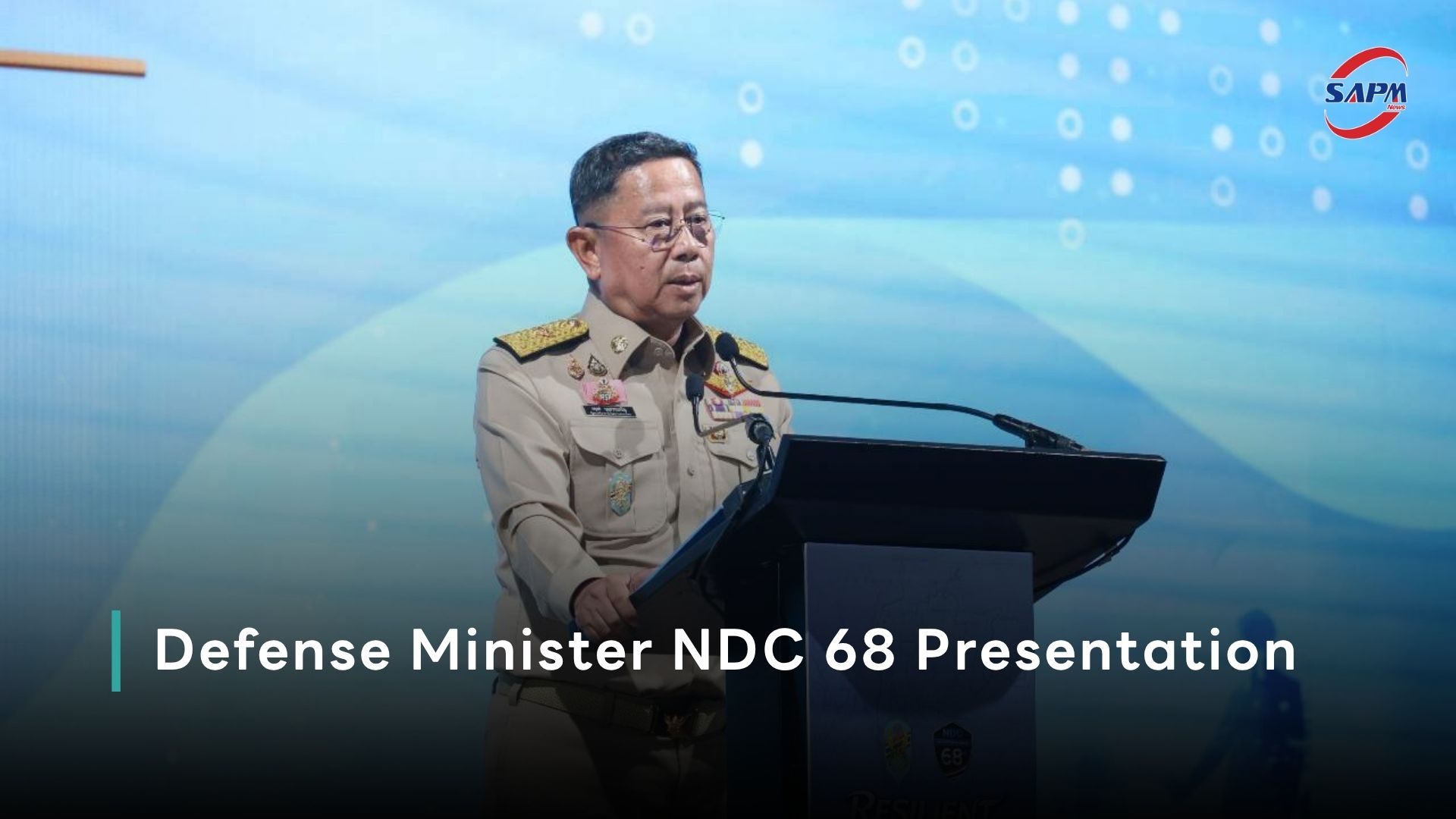
Today (8 September 2026) at 2:30 PM, at the National Defence College (NDC), Lt. Gen. Adul Bunthamcharoen , Minister of Defense ,Presided over the presentation of study findings by NDC Class 68 students. In his remarks, he commended the Class 68 students, noting that Thailand is undergoing rapid change. He emphasized that national security is no longer defined solely by robust military capabilities. He drew a comparison between the 2011 conflict with Cambodia and the two rounds in 2026, highlighting the evolution of the situation and the uncertainty regarding how a potential third round might unfold.
Lt. Gen. Adul further stated that Thailand must possess the capacity for defense alongside recovery and steady progress when facing new forms of crises. He acknowledged that the country is confronting increasingly complex and interconnected challenges—ranging from geopolitical conflicts, natural disasters, and pandemics to cyber threats and climate change. Consequently, building the nation is not the mission of any single agency but the duty of everyone. As Defense Minister, he endorsed the concept of "exploding from within" (growth driven from within) as the correct approach. Furthermore, the public must be equipped with the knowledge and understanding to cope with various types of crises, while the government sector must maintain interconnected operational systems. Since we cannot predict what might happen...
Lt. Gen. Adul continued by stating that while the military possesses readiness within a holistic security framework, this requires collaboration across all sectors—thinking and acting together—to leverage existing capabilities in support of the public and the nation. While current efforts may not be perfect, they are subject to continuous improvement, including the development of digital technologies and artificial intelligence. Furthermore, the approach must shift from merely reacting to crises after they occur toward anticipation and prevention. In this regard, he highlighted five key points:
1. Establishing an early warning and predictive system to alert the country before damage occurs (citing the contrast between the effective management in Nan and the less effective response in Hat Yai).
2. Fostering cooperation between the public and private sectors, as well as engaging the general public as a functional mechanism during times of crisis.
3. Strengthening communities, which serve as the first line of defense against emerging threats.
4. Investing in future technologies, such as AI.
5. Building security through public participation.
Lt. Gen. Adul concluded by noting that recovery following a crisis entails learning, adaptation, and emerging stronger. A resilient Thailand is not one that has never faced a crisis, but rather one that, upon facing a crisis, is ready to learn, adapt, and emerge stronger than before.
Copywriter: Siam Associated Press (SAP) Editorial Department
Pictures: Some illustrations come from the Internet. If there is any infringement, please contact us to delete it.
Source of material: official media /online news
273/3 Ratchadaphisek Rd., Ratchadaphisek, Din Daeng, Bangkok, 10400
Email reporter@sapnewsth.com
Tel. 099 569 5964