



Cabinet Takes Note of Transport Ministry’s Acceleration of 20 Subordinate Laws under “Common Ticketing Act”, Citing Public Hearing Adjustments for Delay and Expressing Confidence in Full Completion Within 2026
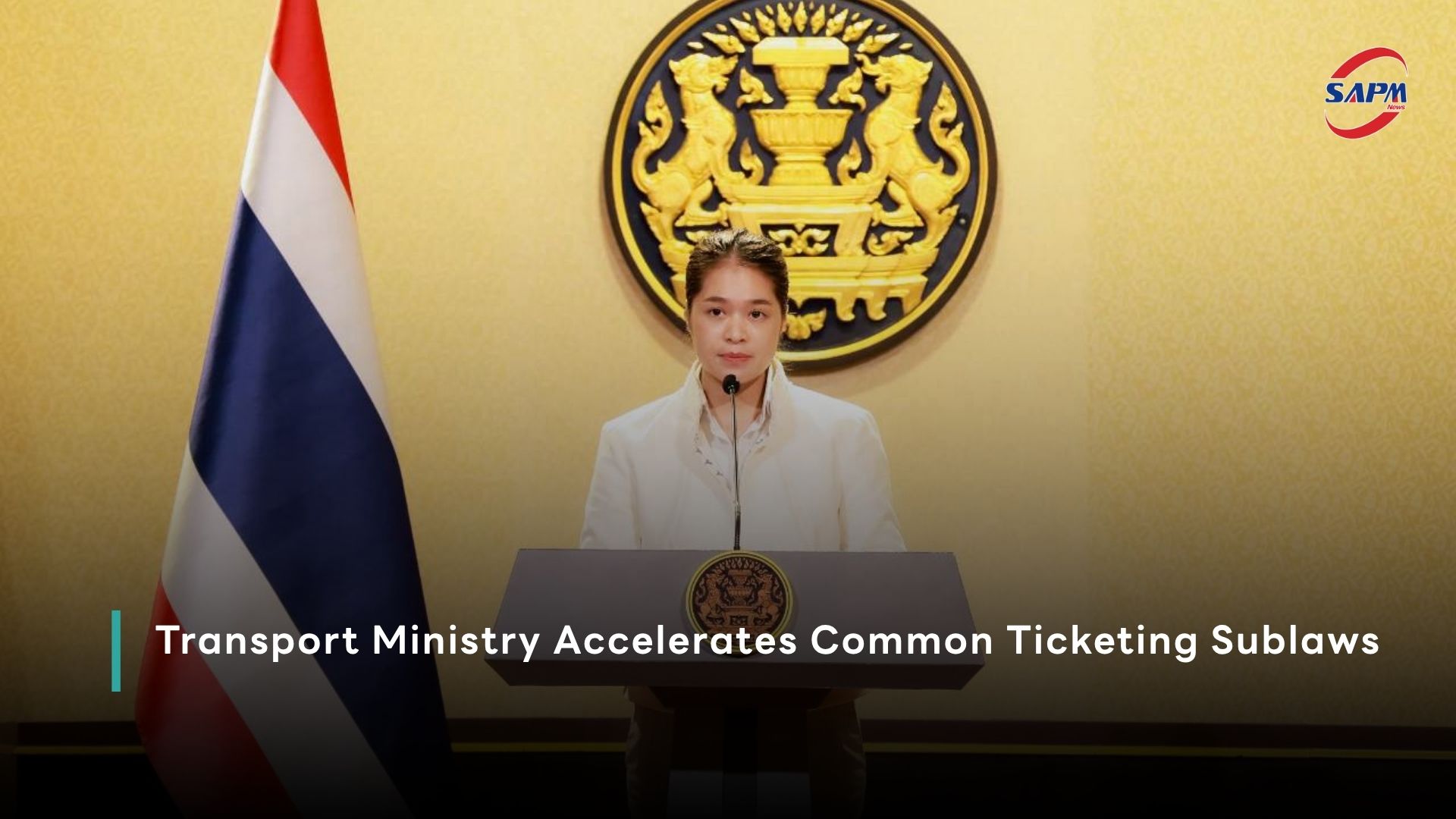
Today (20 October 2026) at 2:00 PM, at Government House, Ms. Ploythale Laxameesangchan, Deputy Government Spokesperson, revealed that the Cabinet acknowledged the reasons and necessity for the inability to complete the issuance of subordinate laws within the timeframe specified under the Management of Common Ticketing System Act, B.E. 2568 (2025), as proposed by the Ministry of Transport (MOT). The Cabinet also directed the Ministry of Transport to consider and proceed in accordance with the observations of the Office of the Council of State.
Ms. Ploythale stated that the issuance of ministerial regulations, announcements, and rules under the Management of Common Ticketing System Act, B.E. 2568, proposed by the Ministry of Transport, is an action under Section 53 of the said Act. Section 53 mandates that the issuance of ministerial regulations, announcements, and rules under this Act must be completed within 180 days from the date the Act comes into force. If completion is not possible, the Minister shall report the reasons for the inability to proceed to the Cabinet for acknowledgment (with the subordinate laws originally required to be finalized by June 25, 2026). However, due to the Recommendation of the Law Development Committee on Public Hearing of Stakeholders for the Drafting of Laws (No. 2), B.E. 2569 (2026), which extended the duration for public consultation on draft legislation via information technology systems from not less than 15 days to not less than 30 days, as well as requiring agencies to hold public hearings starting from the principle/key concept stage through to the post-drafting stage to align with the intent of the Act on Criteria for Drafting Legislation and Evaluation of Law Efficiency, B.E. 2562 (2019), the implementation plan for issuing subordinate laws under the Management of Common Ticketing System Act, B.E. 2568 experienced delays. In addition, as the draft subordinate laws contain contents that directly affect fare collection systems and the revenue structures of transit operators across all sectors, the Ministry of Transport required additional time for joint consultation with relevant transit service providers. This is a crucial step for gathering technical feedback and practical constraints to refine the draft subordinate laws so they can be effectively implemented and enforced. Therefore, it was necessary to report the reasons for the delay to the Cabinet for acknowledgment. Nevertheless, the Ministry of Transport has completed the drafting of 20 subordinate laws under the Management of Common Ticketing System Act, B.E. 2568, and expects to fully finalize and issue all 20 subordinate laws within 2026.

Ms. Ploythale further stated that issuing ministerial regulations, announcements, and rules under the Management of Common Ticketing System Act, B.E. 2568 establishes operational criteria for the common ticketing system at a systemic level, supporting common ticketing operations and the actions of relevant national agencies, which will yield key benefits for the public and elevate the nation's public transport services as follows:
Reduction of living expenses for the public: Establishing joint fare rates by waiving duplicate entry fees between different operators will directly result in an overall reduction of service fees.
Convenience and speed in travel: Citizens can seamlessly connect between mass rapid transit (MRT/skytrain), public buses, and passenger ferries using a single card or payment medium.
Alleviation of traffic congestion and pollution: The common ticketing system will encourage citizens to shift their mode of travel from private vehicles to public transportation, thereby helping to reduce traffic congestion, lower environmental impacts, integrate technological standards into a unified framework, and foster a joint fare rate structure.
Enhanced regulatory efficiency for the government: Providing the public sector with legal mechanisms to regulate common ticketing operations, control service quality, allocate revenue among operators, and protect service users' personal data effectively.
In this regard, the Office of the Council of State submitted its opinion for the Cabinet’s consideration, viewing that the Cabinet could approve the matter. It also noted that the Ministry of Transport (Office of Transport and Traffic Policy and Planning - OTP) should expedite the issuance of ministerial regulations, announcements, and rules under the Management of Common Ticketing System Act, B.E. 2568, so that national common ticketing management in public transport can proceed efficiently without impairing the legal enforceability of the provisions under the Management of Common Ticketing System Act, B.E. 2568.
Photo : Weeraphat Ratsameerueangrong
Copywriter: Siam Associated Press (SAP) Editorial Department
Pictures: Some illustrations come from the Internet. If there is any infringement, please contact us to delete it.
Source of material: official media /online news
273/3 Ratchadaphisek Rd., Ratchadaphisek, Din Daeng, Bangkok, 10400
Email reporter@sapnewsth.com
Tel. 099 569 5964