



“MP Nan” Exposes Illegal Toxic Waste Dumping Ring; Demands Government Inspect Factories and Crack Down on Corrupt Officials
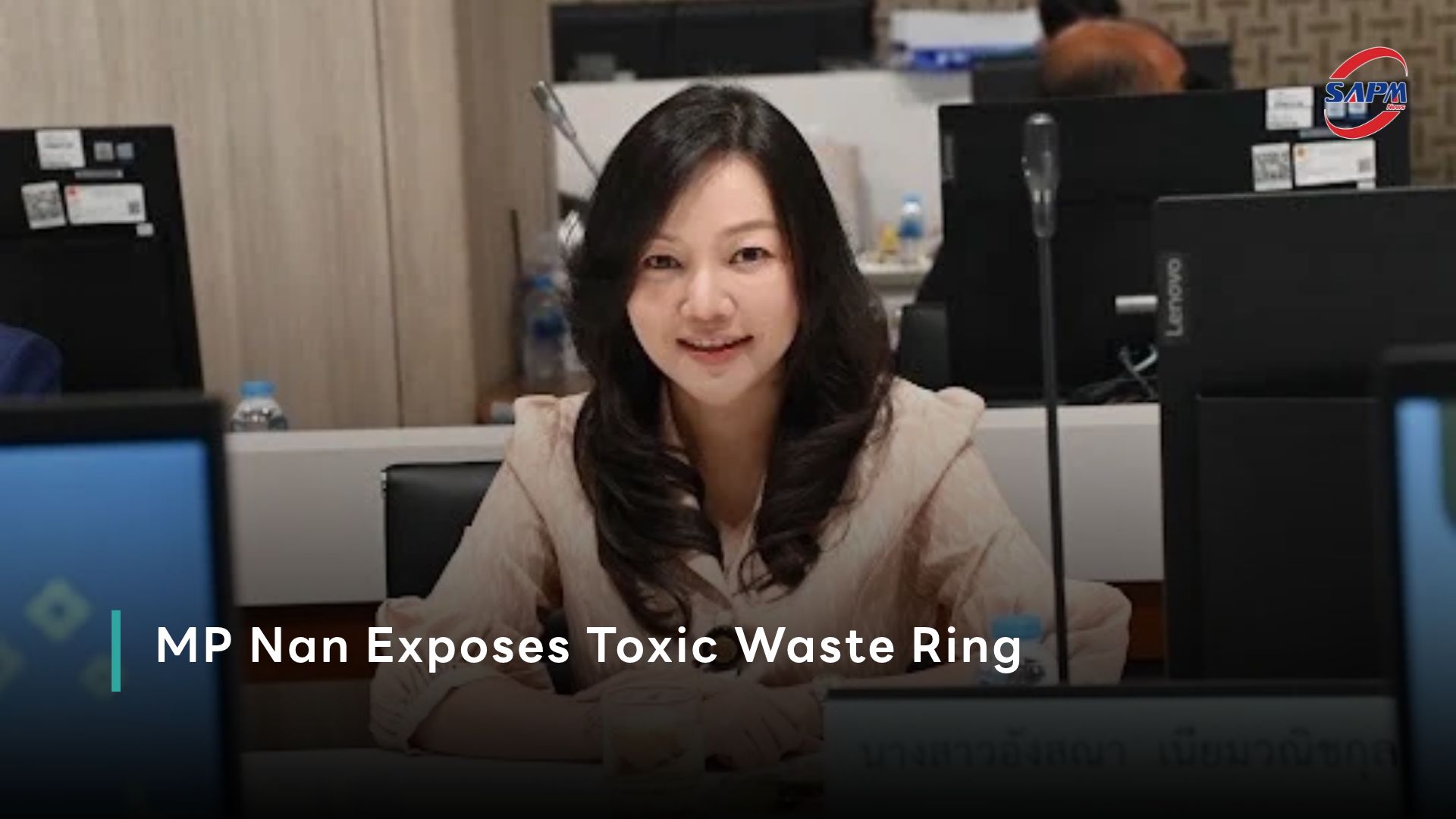
On 3 November 2026, Ms. Angsana Niamwanichkul, a party-list MP and Deputy Secretary-General of the Economic Party, spoke regarding the illegal dumping of industrial waste, electronic waste (e-waste), and toxic substances into the environment. She highlighted that the issue of toxic waste in Thailand is deeply concerning; even some legally licensed facilities fail to adhere to pollution control measures, while government agencies have fallen short in their oversight responsibilities.
Ms. Angsana noted that prior to becoming an MP, she conducted field research on waste issues across several provinces. She discovered that some landfills lacked proper systems to prevent wastewater from leaking into natural water sources, leading to the long-term accumulation of pollution all while government agencies, tasked with direct supervision, failed to intervene. She further shared that she had once been approached with an offer to transport waste away from a site for use as a landfill or to be dumped elsewhere, at a cost suspiciously lower than the standard, legally mandated disposal process. Additionally, she received reports of shredded electronic waste being used as fill material for land in residential areas. This could lead to the public being exposed to toxic substances without their knowledge.
“People don’t even have the right to know what they are being exposed to. It is unfair to the public. Both the party that commissioned the disposal and the party that carried it out must face legal action,” Ms. Angsana said.
Ms. Angsana added that she has already forwarded the information she received to the relevant parliamentary committee for review, with the aim of investigating and tracking down those involved. She also urged government agencies to take a stricter stance on recycling plants and industrial waste disposal sites. If any facility is found to be illegally accepting electronic waste or committing serious violations of its operating license, decisive action up to and including permanent closure or the revocation of the license must be taken. Furthermore, she pointed out that the current inspection process, which often involves prior notification, creates a loophole that allows unscrupulous operators to move or conceal evidence before officials arrive. She proposed adopting a proactive inspection approach, conducting unannounced visits to reveal the true state of operations.
Regarding the issue of providing relief to those affected by flooding and pollution, Ms. Angsana argued that the government should not wait for affected individuals to come forward with complaints or queue up for assistance. Instead, officials should proactively visit the affected areas to assess the damage themselves, as the government already possesses data on which locations have been impacted. She also proposed the enactment of legislation to hold factory operators liable for damages caused to the public even in cases involving natural disasters if the facilities failed to implement adequate risk-prevention measures.
On the matter of importing industrial waste from abroad, Ms. Angsana further questioned the conduct and performance of customs officials. Claims of insufficient personnel or equipment cannot justify any negligence in the inspection of goods passing through checkpoints. If a checkpoint is opened for the import of goods, the responsible agency is obligated to ensure that adequate staff are present to carry out their duties in accordance with the law.
Ms. Angsana further noted that the Economic Party is currently pushing for legislation to increase penalties for corruption. The party has already secured the signatures of 20 Members of Parliament (MPs) to propose a bill that would impose harsher punishments on corrupt state officials and those who offer bribes in serious cases up to the death penalty in instances where the actions cause widespread harm to the public. It is believed that strengthening the law will help curb corruption, which currently creates loopholes that facilitate ongoing illicit activities.
Ms. Angsana added that the Economic Party welcomes complaints from the public regarding the illegal importation, dumping, or stockpiling of industrial waste. Citizens can report such incidents directly to the party, which will then coordinate investigations and monitor the actions taken by state authorities.
“We cannot allow the country to continue in this state. State officials have a duty to protect the public; they must not allow wrongdoers to use their wealth to place themselves above the safety and lives of the Thai people,” Ms. Angsana said.
Copywriter: Siam Associated Press (SAP) Editorial Department
Pictures: Some illustrations come from the Internet. If there is any infringement, please contact us to delete it.
Source of material: official media /online news
273/3 Ratchadaphisek Rd., Ratchadaphisek, Din Daeng, Bangkok, 10400
Email reporter@sapnewsth.com
Tel. 099 569 5964