



Israelis and Palestinians Celebrate! Ceasefire Reached Under Trump’s Peace Plan - A New Beginning of Hope in the Middle East
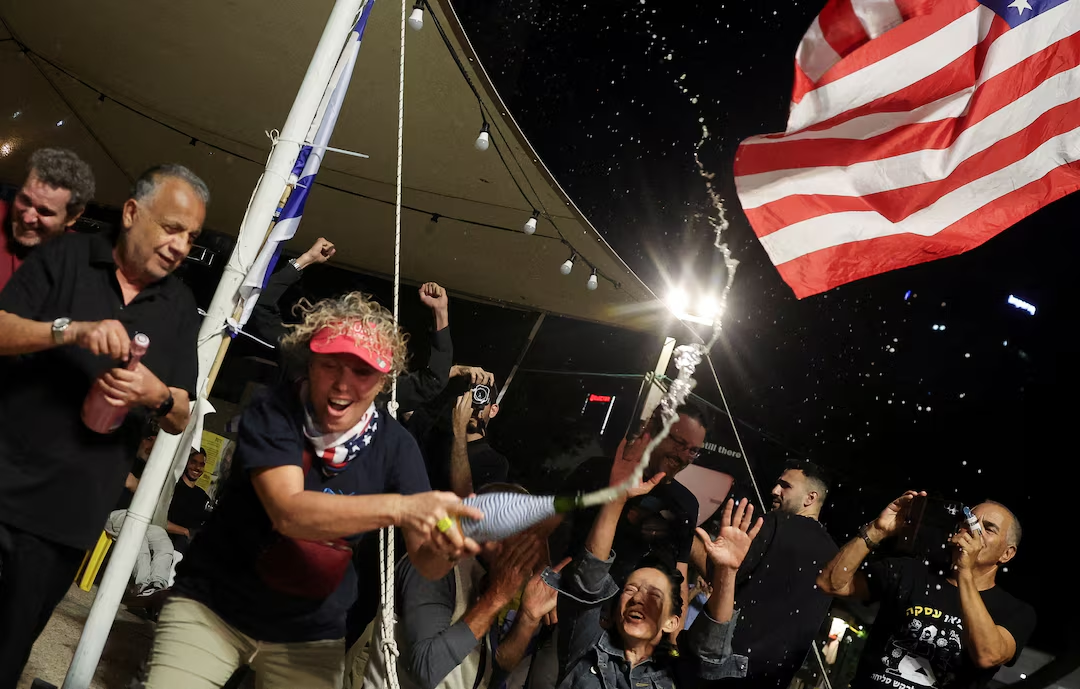
People celebrate after U.S. President Donald Trump announced that Israel and Hamas agreed on the first phase of a Gaza ceasefire, at the "Hostages square", in Tel Aviv, Israel, October 9, 2025. REUTERS/Ronen Zvulun
On October 9, 2025, Israel and Palestine expressed cautious optimism after announcing a ceasefire and hostage exchange agreement under a peace plan brokered by U.S. President Donald Trump, aimed at ending the long-running war in Gaza. The deal marks the first phase of Trump’s 20-point framework, achieved through indirect talks in Egypt, just one day after the second anniversary of Hamas’s cross-border attack that triggered Israel’s large-scale military campaign.

Palestinians celebrate in the streets of Khan Younis, Gaza, after the announcement of a ceasefire agreement between Israel and Hamas. /Photo: Reuters
If fully implemented, the agreement could represent the most significant step toward peace after years of failed attempts. The protracted war had expanded into a regional conflict, drawing in countries such as Iran, Yemen, and Lebanon. The announcement sparked celebrations in Israel and Gaza alike. Israeli families of hostages set off fireworks, while Gazans applauded and cheered. Abdul Majid Abd Rabbo, a resident of Khan Younis, said tearfully, “Thank God for the ceasefire, for the end of bloodshed and killing.”
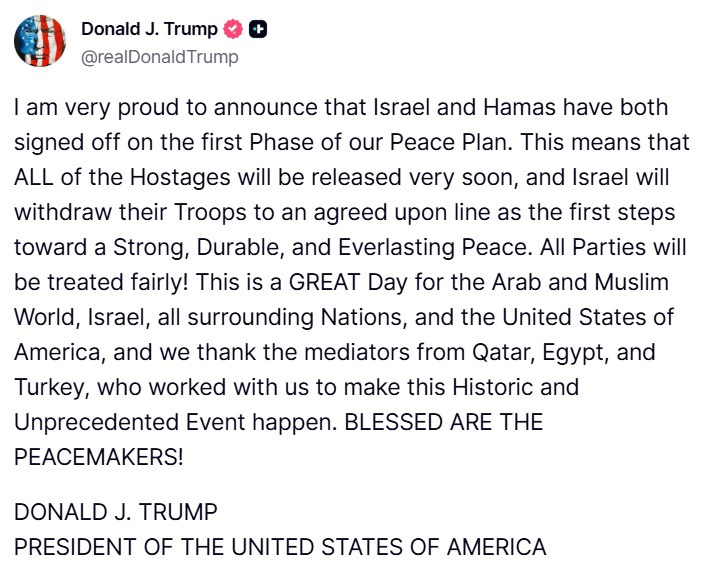
A screen grab of a post by U.S. President Donald Trump on his Truth Social account, announcing that Israel and Hamas have signed off on the first phase of the U.S.-proposed Gaza deal, allowing for the release of all Israeli hostages, on October 9, 2025. Social Media/via SAP NEWS
President Trump announced the breakthrough on Truth Social at 6:51 p.m. (Est.), declaring, “I am very proud to announce that Israel and Hamas have signed the first phase of our peace plan.” He pledged that all hostages would be released soon, and Israel would pull its forces back to agreed positions, describing it as the first step toward “strong, lasting, and eternal peace.” However, the agreement leaves crucial details unresolved, raising concerns it could collapse like previous peace efforts.
Israeli Prime Minister Benjamin Netanyahu said he would convene his cabinet to approve the deal, calling it “a diplomatic achievement and a moral and national victory for Israel.” He argued the conflict had reshaped the Middle East in Israel’s favor after assassinations of Hamas and Hezbollah leaders supported by Iran. Still, international criticism has mounted, with academics, rights experts, and UN investigators accusing Israel of committing “genocide.” Israel has rejected the claims, insisting its actions were self-defense following Hamas’s 2023 assault.
Hamas confirmed the deal, saying it includes Israeli troop withdrawal, hostage-prisoner exchanges, and recognition of Palestinians’ right to resist until independence is achieved. Gaza officials reported more than 67,000 deaths, with most of the territory reduced to rubble. Israel, meanwhile, reported around 1,200 deaths and said 251 civilians had been taken hostage into Gaza. Officials believe about 20 of the 48 remaining hostages are still alive.
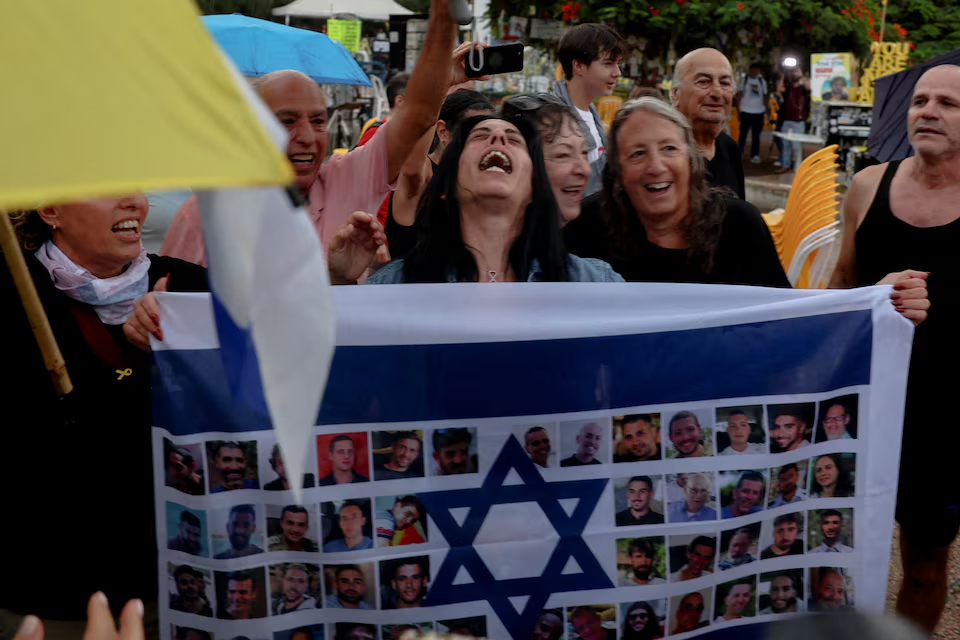
Einav Zangauker, the mother of hostage Matan Zangauker, reacts holding an Israeli flag with photos of hostages, after U.S. President Donald Trump announced that Israel and Hamas agreed on the first phase of a Gaza ceasefire, at the "Hostages square", in Tel Aviv, Israel, October 9, 2025. REUTERS/Ronen Zvulun
In Tel Aviv, Israeli families of hostages gathered at “Hostage Square” following the announcement. Hatan Angrest, whose son is among the captives, thanked Trump for giving his family hope of reunion. A Hamas source said living hostages would be released within 72 hours of Israel’s government approval, while recovering the bodies of roughly 28 dead hostages could take longer. Yet key questions remain unresolved, including Gaza’s post-war governance and Hamas’s political future.
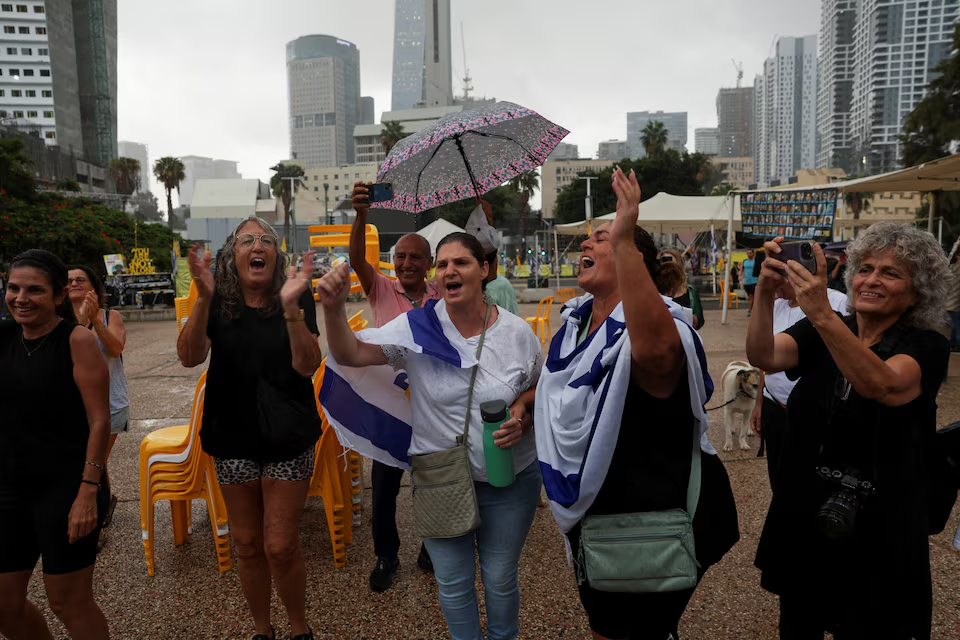
People celebrate after U.S. President Donald Trump announced that Israel and Hamas agreed on the first phase of a Gaza ceasefire, at the "Hostages square", in Tel Aviv, Israel, October 9, 2025. REUTERS/Ronen Zvulun
Under the next phase of Trump’s plan, an international body led by Trump and former UK Prime Minister Tony Blair would oversee Gaza’s reconstruction. Various Arab states have urged that the plan eventually pave the way for Palestinian statehood, a prospect Netanyahu has firmly rejected. The U.S., Western governments, and Arab allies have all agreed to exclude Hamas from post-war administration. Hamas, however, said it would hand governance to a technocratic Palestinian Authority-backed government with Arab and Muslim support, while rejecting foreign control and refusing to disarm as long as Israeli forces continue occupying Palestinian land.
Source: Reuters
Copywriter: Siam Associated Press (SAP) Editorial Department
Pictures: Some illustrations come from the Internet. If there is any infringement, please contact us to delete it.
Source of material: official media /online news
Copywriter: Siam Associated Press (SAP) Editorial Department
Pictures: Some illustrations come from the Internet. If there is any infringement, please contact us to delete it.
Source of material: official media /online news
273/3 Ratchadaphisek Rd., Ratchadaphisek, Din Daeng, Bangkok, 10400
Email reporter@sapnewsth.com
Tel. 099 569 5964