



“Varawut-Veerayooth-Korn-Suksit” present their policy vision and join a discussion with foreign correspondents
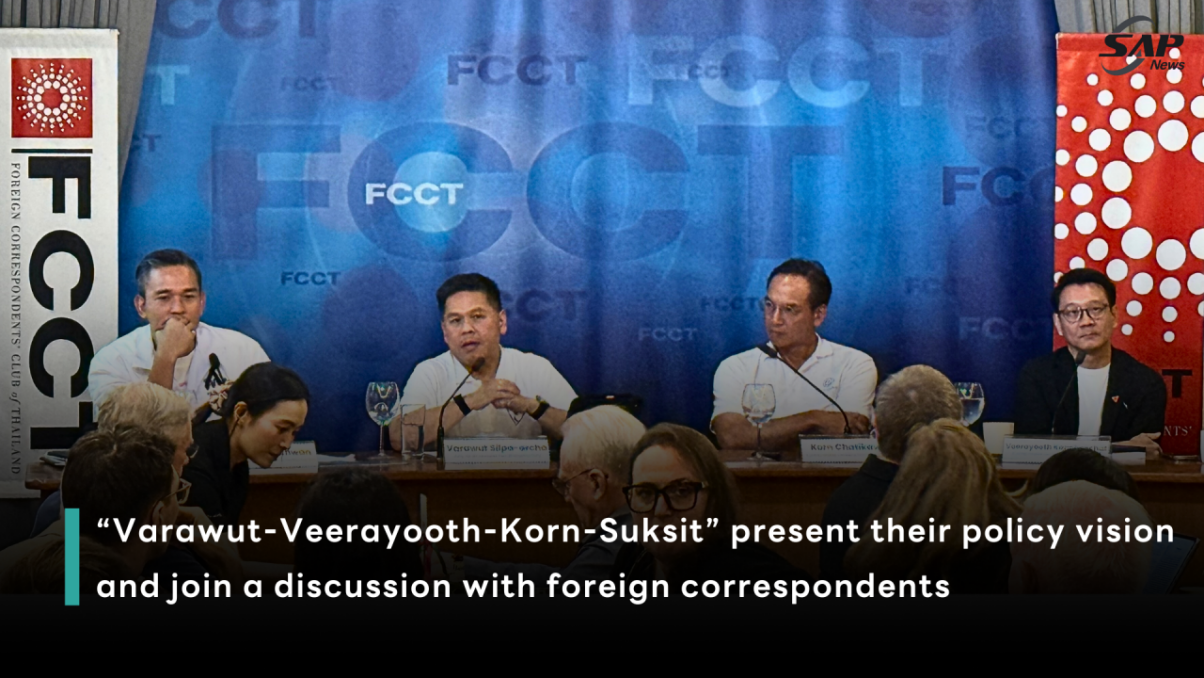
On January 15, 2026, 7.00 PM, at Foreign Correspondents' Club of Thailand, the representatives from four parties which is Varawut Silpa-archa from Bhumjaithai Party, Veerayooth Kanchoochat from People’s Party, Korn Chatikavanij from Democrat Party, and Suksit Srijomkhwan from Pheu Thai Party join the discussion to present their policies on border tensions,economic headwinds, foreign policy, and constitutional amendment.

Varawut Silpa-archa from Bhumjaithai Party./ Photo: Annie via SAP NEWS
On the border tensions, in which Thailand and Cambodia have prolonged conflict since mid-to-late 2025, Varawut as a government party stated that Thai attempted any possible ways to preserve territory integrity, sovereignty, and pursue peace. He believes that the best solution to seek peace is bilateral negotiation since no country will know the best about the conflict more than Thailand and Cambodia. Nevertheless, even though the current government is strict with the peaceful solution and harmony between neighboring countries, he reaffirmed that if Thai;and’s sovereignty and integrity were threatened, we need to be protected.
Suksit said that the sustainable solution to tackle border tension is to suppress the scammers which he strongly believe that Pheu Thai Party can successfully push this agenda along with delivering the fact to the other countries that Thailand is not the invader country and aim to terminate the conflict with peaceful solution. He also stated that Thailand is the only possible country in this region that could be the leader in suppressing scammers through active and effective solutions.
Veerayooth indicated that we should consider this conflict as a hybrid warfare since this war consists of both traditional and new forms of war such as military power, money laundering, information operation, and foreign media and affairs. By considering it as a hybrid warfare, we can resolve this issue by uphold Thailand’s role as an international anti-scam center which needs the alliances to exchange the data information together with diplomatic and proper militarial methods.
While Korn said that the main solution to get through this issue is talking, which was laid by ceasefire negotiation in order to clear the path to bring the issue back on the talking stage. As well as the PM 2.5 issue, Thailand should talk with the involved stakeholders in order to bring well-being back to the people around the border both Thai and neighboring countries. He highly hopes that this upcoming election together with ceasefire negotiation will lead Thailand in a good term as a neighbor country.

Veerayooth Kanchoochat from People’s Party./ Photo: Annie via SAP NEWS
Regarding economic issues, amid the continuous slowdown across various business sectors in Thailand, Veerayooth stated that Thailand could stimulate the economy through three key measures. First, addressing the economic black holes where money tends to flow through the informal economy. Second, supporting SMEs through the receipt lottery policy, which would sustainably increase demand while also encouraging small retailers to enter the tax system. Third, promoting competition by shifting the mindset from focusing on Product Champions to emphasizing participation in strategic global competition, in line with the evolving dynamics of the world economy.
Suksit stated that Pheu Thai’s core economic policy focuses on debt relief, enabling the majority of Thai people burdened by debt to re-enter economic competition. Regarding the cost of living crisis, Pheu Thai emphasizes reducing public transportation costs, increasing the Half-Half Plus scheme to a 70:30 ratio, with the government covering 70% and citizens paying 30%, and declaring a war on poverty by providing a minimum income subsidy of 3,000 baht per person per month. In addition, Pheu Thai is committed to transforming Thailand into a high-income industrialized country, enhancing the nation’s competitiveness in manufacturing and service industries.
Varawut discussed policies to promote investment, including the Quick Big Win Plus initiative. He also addressed the continuation of the Half-Half Plus scheme but maintained that the ratio should remain 50:50, as the objective of the policy is to help alleviate essential living expenditures while fostering sustainable economic stimulation. Increasing the government’s share, he argued, would be akin to “throwing fish into a pond,” potentially weakening competitive incentives. Furthermore, the Bhumjaithai Party proposes restructuring Thailand’s industrial sector toward green industries to eliminate trade barriers, emphasizing that Thailand must adapt to global production standards or risk being excluded from international trade.
Korn stated that Thailand has yet to truly move beyond the concept of free and fair competition, as trade-related laws and regulations continue to obstruct investment and economic growth. For him, the key to Thailand’s economic development lies in trade liberalization and bureaucratic reform, supported by strong political will within the government and the integration of technology into public administration. This includes reforming trade regulations and effectively utilizing existing national resources.
On foreign policy, Thailand faces a dilemma regarding its traditional bamboo diplomacy amid intensifying geopolitical competition. Veerayooth noted that Thailand does not need to maintain neutrality based solely on major power dynamics. Instead, Thailand should pursue a “Pro-Thai” diplomacy, evaluating each issue based on whether it benefits the country. Additionally, the People’s Party proposes a foreign policy approach of “Looking North, Looking South”, looking north to strengthen economic ties with East Asian countries by matching Thailand’s needs with what those countries lack, while looking south to develop niche markets.

Korn Chatikavanij from Democrat Party./ Photo: Annie via SAP NEWS
On Korn’s side, he emphasized the importance of ASEAN’s role, expressing a strong commitment to revitalizing the regional framework so that ASEAN can regain meaningful bargaining power when negotiating with major powers. In addition, the Democrat Party prioritizes strengthening international relations by using trade cooperation as a leading mechanism for diplomacy.
Varawut stated that Thailand should be regarded as a small country, and therefore its approach amid intense geopolitical competition should be one of strategic bamboo diplomacy, leaning according to circumstances while keeping Thailand’s national interest as the core guiding principle.
Meanwhile, Suksit noted that Pheu Thai emphasizes a dual-track policy, which involves engaging with the global community while simultaneously strengthening domestic stability. He also referred to a policy previously promoted by Pheu Thai when it led the government, namely the Landbridge project, which aims to establish a new regional logistics hub. He argued that small- and medium-sized shipping operators could utilize this route as an alternative to Singapore’s ports. However, Korn raised concerns that such a large-scale project might not be cost-effective, particularly when compared to Singapore’s ports, which are often preferred by shipping companies.
Lastly, one of the most closely watched and debated issues in Thai society is constitutional amendment. Following this election, voters are not only required to select constituency MPs and party-list MPs, but are also asked to vote on whether they approve or disapprove of drafting a new constitution.
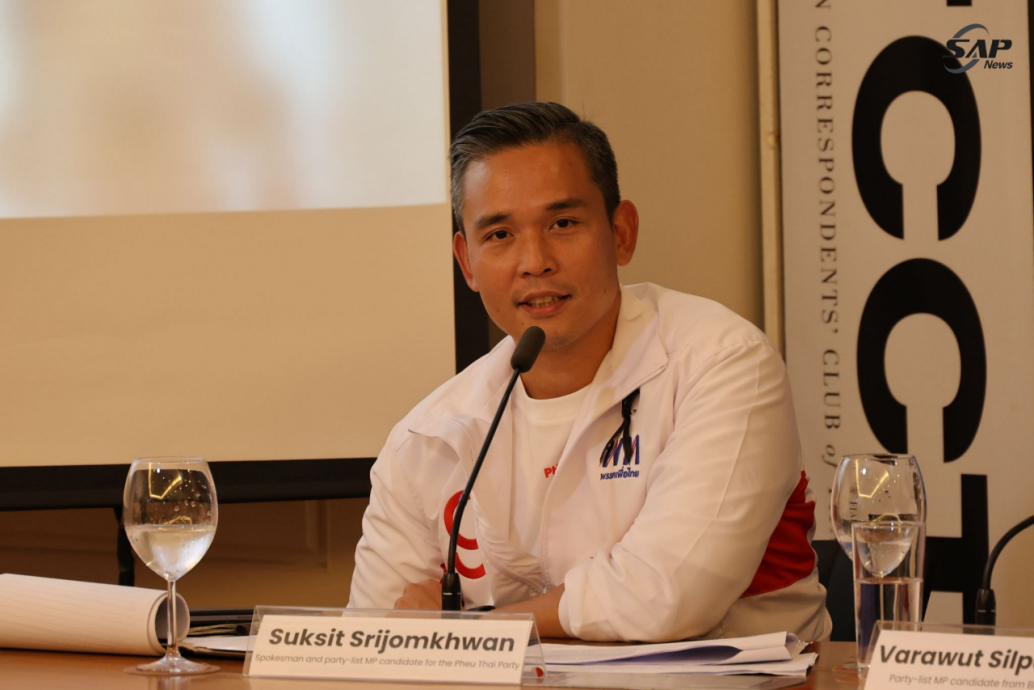
Suksit Srijomkhwan from Pheu Thai Party./ Photo: Annie via SAP NEWS
Suksit stated that Pheu Thai supports the drafting of a new constitution, as his party has been directly affected by the current charter, with two prime ministers from the party being disqualified from politics over the past two years. He further argued that the existing constitution is the source of the Senate and independent organizations whose origins lack democratic linkage to the people. Moreover, he claimed that the constitution tends to facilitate corruption and scammers rather than effectively suppress them.
Varawut stated that he and the Bhumjaithai Party support constitutional amendment as long as Articles 1 and 2 of the Constitution, as well as Article 112 of the Criminal Code, remain untouched. Meanwhile, Korn expressed his support for constitutional amendment but emphasized that it should be limited specifically to the selection process of the Senate and independent organizations. He added that if the referendum result shows public approval for drafting a new constitution and the Democrat Party becomes the leading party in forming the government, he can assure that Articles 1 and 2 will not be amended, and that reforms will be carried out incrementally, article by article.
On Veerayooth’s side, constitutional amendment has been a major issue on which the People’s Party has faced political attacks. He stated that the party holds a clear stance that the current constitution must be amended in order to establish a stable government, create appropriate and accountable independent organizations, and decentralize power from the central government. He believes that amending the constitution to advance these three objectives would help alleviate and ultimately remove obstacles to Thailand’s political and economic development.
Copywriter: Siam Associated Press (SAP) Editorial Department
Pictures: Some illustrations come from the Internet. If there is any infringement, please contact us to delete it.
Source of material: official media /online news
Copywriter: Siam Associated Press (SAP) Editorial Department
Pictures: Some illustrations come from the Internet. If there is any infringement, please contact us to delete it.
Source of material: official media /online news
273/3 Ratchadaphisek Rd., Ratchadaphisek, Din Daeng, Bangkok, 10400
Email reporter@sapnewsth.com
Tel. 099 569 5964