



“Kanok” addressed public concerns about a potential third clash on the Thai-Cambodian border. He noted that the new government must foster understanding with the military
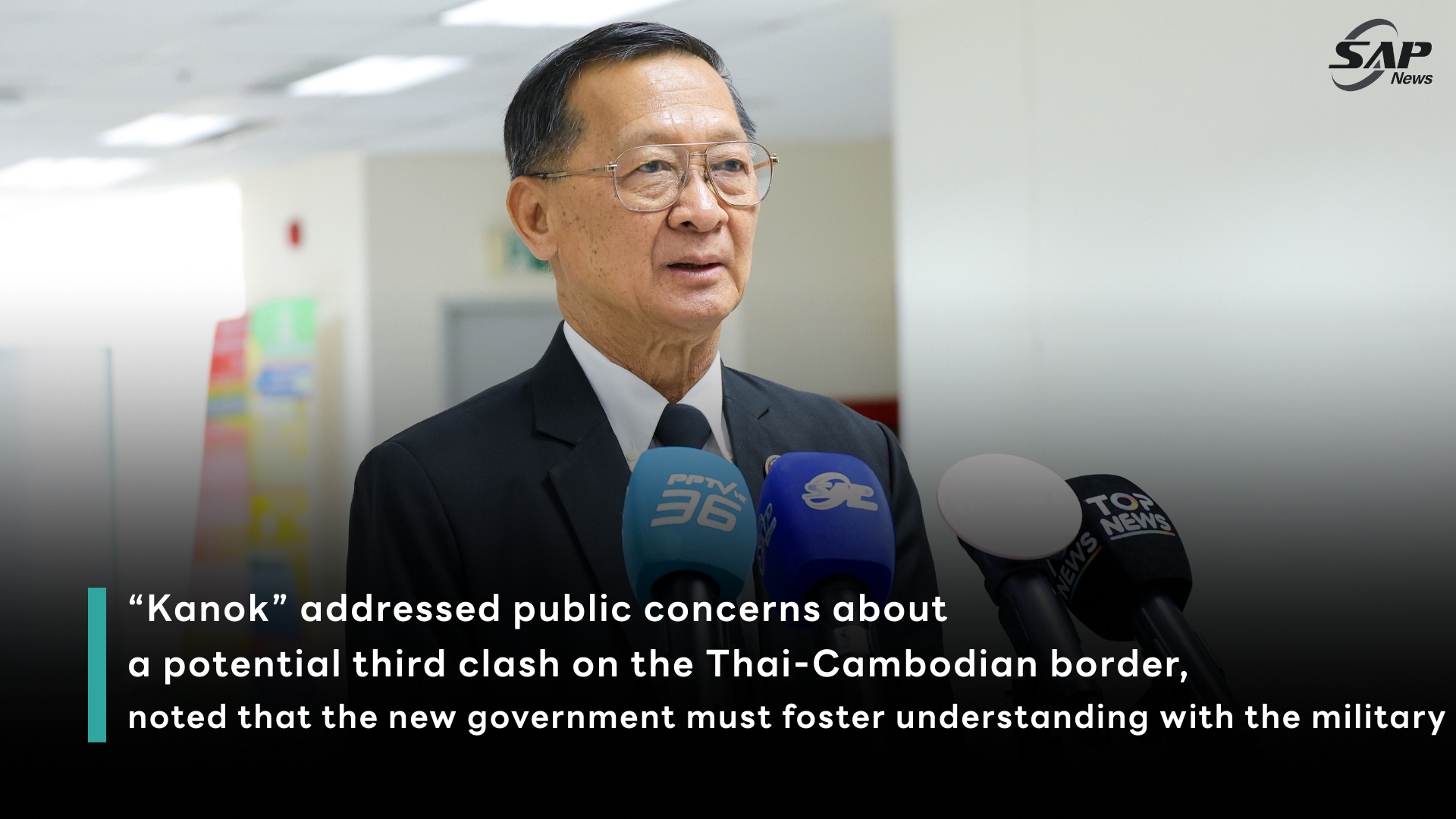
Today (Jan 28) 9:00 AM, at Room 501, Sri Srattha Building, Faculty of Political Science, Ramkhamhaeng University, reporters covered an academic seminar on the topic, "Why do we need a military?: Analyzing the election campaign policies regarding the military of Thai political parties."
The seminar was moderated by Lt. Gen. Dr. Napanan Chanpradab, former Special Advisor to the Army; Lt. Gen. Kanok Netrakaveelina, former Deputy Commander of the 2nd Army Area and Commander of the Suranaree Task Force; and Asst. Prof. Dr. Wanwichit Boonproong, a faculty member of the Faculty of PolScience at Rangsit University and the Advisor to the MinDefense.
During one segment, Lieutenant General Kanok Netrakavesana, former Deputy Commander of the 2nd Army Area and Commander of the Suranaree Task Force, stated that the question many people ask is, "What is the purpose of the military?" He asked if they had ever heard the saying, The country is the home; the military is the fence. The duty of the military is to defend the country and protect the land from enemy invasion. In the past, if there were no fighting, we wouldn't see how the military performs its duty. But we all saw the military's duty from the first battle, which made us understand the characteristics of some of our border areas. For example, the area under the command of the 2nd Army Area is mountainous, while the area under the command of the 1st Army Area is flat. And the border between Chanthaburi and Trat provinces consists of rivers interspersed with mountains. Regarding the fighting in the area under the jurisdiction of the 2nd Army Region, operations are underway to push back Cambodian soldiers and some civilians residing in various areas, totaling 11 locations.
Lieutenant General Kanok further stated that there are still overlapping areas, such as Chong An Ma, Hill 677, Hill 500, Hill 350, Ta Kwai Temple, and especially Ta Muen Thom Temple, where confrontations led to clashes and a second battle, which lasted longer than the first and continued in several areas. We were able to seize several areas and push back Cambodian soldiers.
Lieutenant General Kanok added that in the current situation within the 2nd Army Region, we control most of the mountainous areas, while Cambodia has relocated to the plains. However, several areas remain in conflict. This indicates that a third round of fighting is yet to come, as Cambodia and Thailand have not yet withdrawn their troops from some areas. Therefore, the 2nd Army Region's duty is to try to push the Cambodian forces out. If we don't, we face the problem of Thai soldiers losing landmines and Cambodian soldiers continuing their patrols to provoke and seize more territory. There will be more such incidents, Lieutenant General Kanok added. But the two battles will provide a picture and an answer for the public to understand why soldiers exist. Before reaching that point, let's look back and consider who soldiers are. Soldiers are citizens who have undergone tactical and military training according to rank and unit structure. They are trained in various aspects, combining different training methods for combat in diverse terrains. Therefore, we need soldiers who are highly skilled. Consider the mental fortitude required to attack an enemy bunker or fortified area; it's a life-threatening situation. Furthermore, commanders at all levels strive for success, which is to push Cambodia back and seize their objectives with minimal casualties. All of this emphasizes that this is the duty of the military.
When asked which political party's policy is most suitable for the military at this time, Lieutenant General Kanok said, Politicians may have knowledge and abilities in other areas, but they may lack knowledge and expertise in the military and soldiers. Even forming a government requires understanding national security and the military's operations. Some believe the military hasn't been fully addressed. Therefore, any government that comes into power must understand the current situation and the military's needs. The resources used by the military in the two previous battles must be replenished by the government to ensure readiness for a third conflict, said Lieutenant General Kanok. He explained that the primary resource used was ammunition, which needs to be replenished. Furthermore, Cambodia has developed new weapons to counter, such as those capable of fighting F-16 fighter jets. Therefore, we must consider what weapons we will use to fight them, not rely on the same tactics, as the opposing side is also developing its weapons. Regarding whether there will be fighting between now and February 8, 2026, he stated that there is currently no indication of fighting, but we will assess Cambodia's readiness based on the two previous battles.
Lieutenant General Kanok added that the trenches Cambodia has dug in Trat province are in a zigzag pattern, a tactical design. As for the Cambodian military bunkers shown in the images, he did not comment further. There are triangular concrete slabs placed along the border opposite Hill 350, about 1 kilometer from the Thai border. The presence of these slabs indicates that the construction is unfinished. Once completed, the area will need to be covered with soil for cover.
Lieutenant General Kanok reiterated that this signals Cambodia's unwillingness to cooperate with Thailand. He added that he hopes the new government will understand the military's needs and provide enhanced support to strengthen national defense. This is to foster cooperation for the nation and to protect the land for future generations.
During a discussion, a student asked about the possibility of abolishing conscription. Lieutenant General Kanok responded, If conscription is abolished, who will fight? Without combatants, who will defend the land?.
Copywriter: Siam Associated Press (SAP) Editorial Department
Pictures: Some illustrations come from the Internet. If there is any infringement, please contact us to delete it.
Source of material: official media /online news
Copywriter: Siam Associated Press (SAP) Editorial Department
Pictures: Some illustrations come from the Internet. If there is any infringement, please contact us to delete it.
Source of material: official media /online news
273/3 Ratchadaphisek Rd., Ratchadaphisek, Din Daeng, Bangkok, 10400
Email reporter@sapnewsth.com
Tel. 099 569 5964