



The Army spokesperson explained the delay in disbursing allowances for soldiers fighting on the border
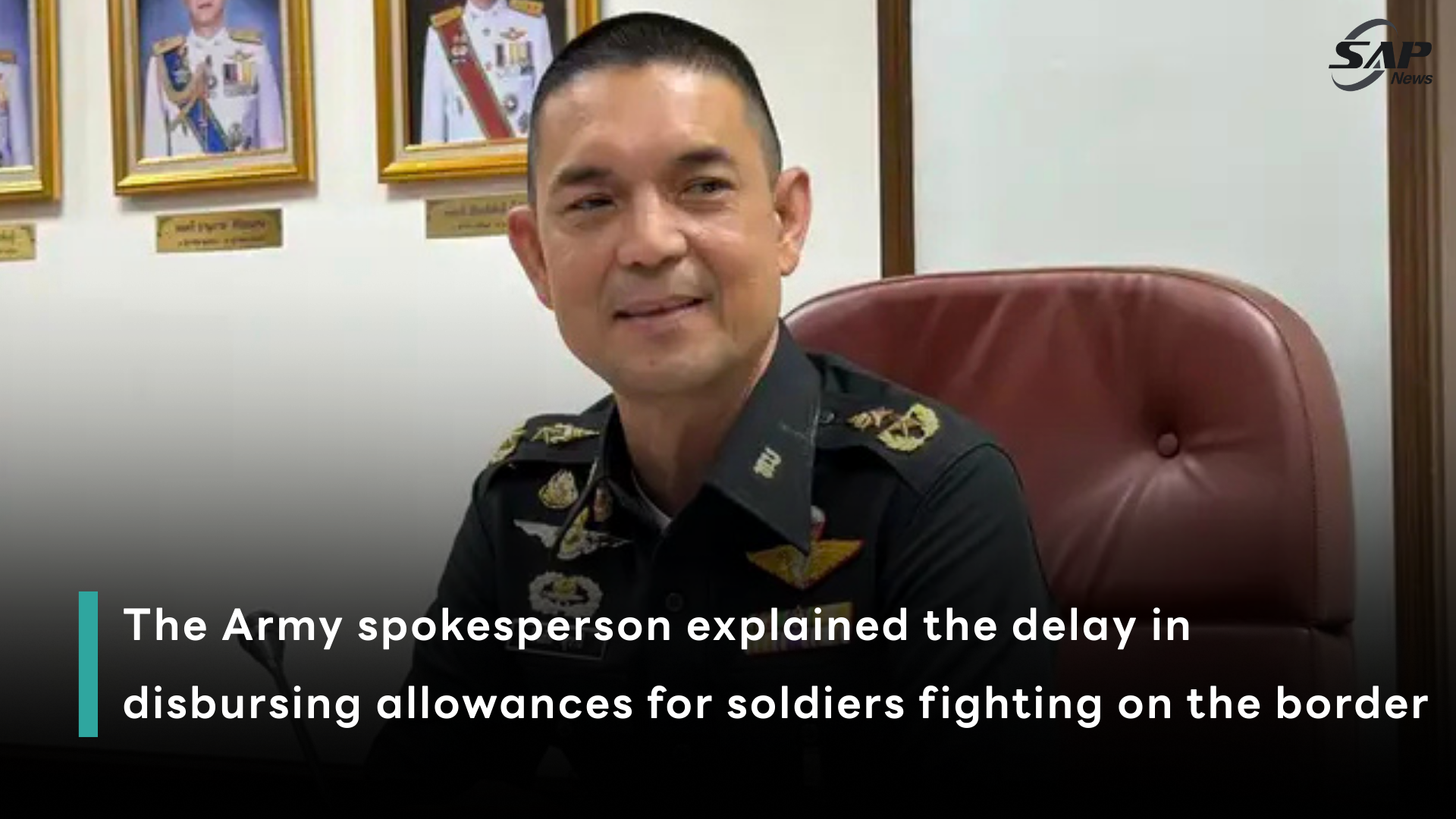
Today (Jan 30) Reporter reported that on Jan 29 , 2:40 PM at the Army Headquarters, Major General Winthai Suwaree, Secretary of the Army and Army Spokesperson, clarified the delay in disbursing allowances for soldiers in the Thai-Cambodian border conflict area. He addressed the issue of General Phana Klaewplodthuk, the Army Commander, stating that upon learning of the matter, the Army Commander took immediate action. This issue had been ongoing for two to three weeks. While it's natural to provide support to fellow soldiers, the deployment of a large number of reinforcements—approximately 30,000-40,000 personnel—was not included in the annual budget, which is allocated for a normal force of 7,000-8,000 personnel.
However, due to the fighting, the army commander decided to deploy a significantly larger number of troops. As the number increased, but the regular budget consideration had already passed in mid-year, June, a temporary solution was implemented as designed by the government: using the central budget. However, for October, the Army, having received the figures, proceeded with the budget request and received it last week. This budget was then distributed to various units. The next step is for the units to pay the personnel. Before that, the Army resolved the issue by using all of its reserve funds for allowances, as the central budget request from the government was still awaiting approval. The entire budget was used, leaving nothing behind.
The funds were distributed primarily to enlisted soldiers, with non-commissioned officers receiving only a portion. This was a management method. Sometimes, communication within the units may not have been detailed enough. This is a sensitive issue that the Commander-in-Chief of the Army considers important, as the Army's core responsibility is the welfare of its personnel. Therefore, reserve funds were used to distribute the funds. However, there may not have been complete awareness among all personnel. Regarding other issues of intentional non-compliance, no reports have been received. Any actions deviating from this approach will face severe punishment for failing to manage resources appropriately.
The reporter then asked whether, given previous incidents of allowance embezzlement, this would reassure soldiers performing their duties. Regarding how this is addressed, Major General Winthai stated that such incidents are violations of regulations. If asked whether such incidents exist, he said that if the Army is aware of them, disciplinary action must be taken. He acknowledged that such incidents may have occurred in the past but believes they are unlikely to happen now. Given the large number of personnel in the Army, overseeing such matters presents a significant challenge, but the ultimate goal is to eliminate them entirely. He noted that most personnel with a history of misconduct are non-commissioned officers or enlisted soldiers. He argued that even 1 percent of 100,000 people would be unacceptable in military terms. Currently, if such cases were compiled, it might be around 0.1 percent. While this might be acceptable in peaceful contexts, it must ultimately be eradicated, in accordance with the policy of the Commander-in-Chief of the Army.
Copywriter: Siam Associated Press (SAP) Editorial Department
Pictures: Some illustrations come from the Internet. If there is any infringement, please contact us to delete it.
Source of material: official media /online news
Copywriter: Siam Associated Press (SAP) Editorial Department
Pictures: Some illustrations come from the Internet. If there is any infringement, please contact us to delete it.
Source of material: official media /online news
273/3 Ratchadaphisek Rd., Ratchadaphisek, Din Daeng, Bangkok, 10400
Email reporter@sapnewsth.com
Tel. 099 569 5964