



From the 2017 charter to referendum 2026: Opening a new chapter in thai politics
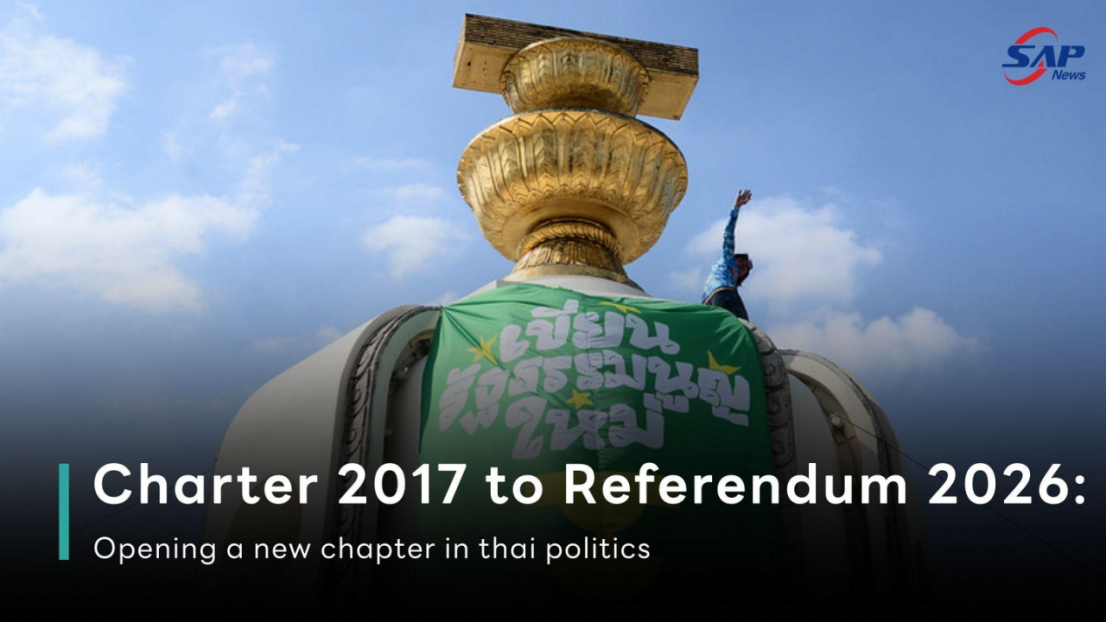
Getting to know the 2026 Referendum
Following the referendum results on Sunday, February 8, 2026, to the question of "Do you agree that there should be a new constitution?", the unofficial results (as of February 11, 2026) revealed that 65.44% of people consented to adjusting the constitution. SAP NEWS investigates what a referendum is and what happens once a referendum is passed.

Photo:Kitsanachai Jitmankong
According to the (unofficial) referendum results, 65.43% of the public approved, marking the first step toward a new constitution.
Approved: 19,978, 736.
Disapproved: 10,553,327.
Abstentions: 2,891,465.
The ranking of the 69th referendum results is as follows:
1st place: Bangkok. Agree: 66.3%, Disagree: 27.6%
2nd place: Central Region. Agree: 62.5%, Disagree: 28%
3rd place: Northern Region. Agree: 62.3%, Disagree: 26.2%
4th place: Northeastern Region. Agree: 59.6%, Disagree: 29.1%
5th place: Eastern Region. Agree: 58.5%, Disagree: 30.2%
6th place: Western Region. Agree: 53.6%, Disagree: 32.9%
7th place: Southern Region. Agree: 45.3% 43.4% disagree.
The Election Commission of Thailand (ECT), a "referendum" is the process of submitting draft laws, draft constitutions, and important national policies to the public for a decision, allowing citizens, who own democratic power, to express their approval or disapproval. It allows citizens to engage in the decision-making process for the country's governance and is a type of direct democracy in which citizens have a direct stake in state administration.
According to Mr. Lertsak Tonto, a legal reform researcher, said a referendum is directly linked to the concept of democracy, or representative democracy, which is a type of governance in which the people retain sovereignty but exercise that power through representatives.
The key principles of a referendum are as follows: the issue being put to a referendum must be significant and affect the interests of the country and its people, without involving any individuals; the wording of the referendum must be clear enough to allow eligible voters to decide whether they "approve" or "disapprove" the issue and both those who support and oppose the issue must have equal opportunity to express their opinions. Additionally, a free and independent referendum must be held. A referendum is declared definitive only if the number of persons voting exceeds the number of abstentions on the issue under consideration.
What are the next steps?
Step1: Referrendum
Disapproval: The process of writing a new constitution cannot continue.
Approval: Those authorized to submit constitutional amendments will propose amendments to Chapter 15/1, Drafting a New Constitution.
Step 2: Parliamentary consideration
According to Section 256, the constitutional amendment draft, Chapter 15/1, "Drafting a New Constitution," will be considered in three readings by Parliament during a joint session.
Step 3: The 2nd Referendum
Once Parliament has approved the constitutional amendment draft, Chapter 15/1, "Drafting a new constitution," before submitting it to His Majesty the King, a referendum will be held in accordance with the law on referendums (second referendum) to determine whether or not the principles, methods, and essential elements of drafting a new constitution, as outlined in the draft Chapter 15/1, "Drafting a New Constitution," are approved or disapproved. (The timeline is based on the Referendum Act.) Regarding the Referendum Act of 2021
Step 4: The 3rd Referendum
A new constitution is developed and presented to Parliament for approval. A third referendum is then held to determine whether the public supports or opposes the new proposed constitution. (The timetable adheres to the procedures and dates outlined in the modified constitution, which was approved in the third referendum.)
Source: The Constitution of the Kingdom of Thailand, 2017; Constitutional Court Ruling 18/2568 (dated September 10, 2025); and the Referendum Act of 2021 and its amendments (No. 2) of 2025.
Comparing the advantages and disadvantages of the 2026 Referendum.
According to the Election Commission of Thailand's (EC) referendum instructions, the advantages and disadvantages are as follows:
Advantages
1. The drafting of a new constitution will facilitate true democratic public engagement. Because the 2017 Constitution was drafted during a period when the country was not controlled by a directly elected government, certain of its articles violate democratic ideals.
2. Several parts of the 2017 Constitution are difficult in terms of enforcement and revision. Drafting a fully new constitution would enable the simultaneous revision of problematic clauses, resulting in a more complete and consistent document.
Disadvantages
Drafting a new constitution may cause more political chaos than altering individual articles, as article-by-article revisions focus debate on specific topics and result in simpler conclusions.
Amending the entire constitution could also be expensive in terms of organizing a referendum.

Walktothefuture event, December 10th,2026 /Photo:ilaw
Thailand’s August 7, 2016 Referendum: A political turning point
On August 7, 2016, Thailand held a national referendum on the 2017 Constitution along with questions. At the time, 29,740,677 Thai citizens (59.4% of the total 50 million eligible voters) used their right to vote. The referendum contained two questions:
1. Draft Constitution Approval: "Do you approve or disapprove of the entire Draft Constitution of the Kingdom of Thailand, B.E…?"
2. Approval of the Accompanying Question: Whether the Senate should participate in the Prime Minister's selection. The question was: “Do you agree that, in order to ensure the continuity of national reform according to the national strategic plan, it should be stipulated in the transitional provisions that, during the first 5 years from the date of the first Parliament under this Constitution…” "The joint session of Parliament shall consider and approve the person who should be appointed as Prime Minister."
The referendum's results were:
1: Accept or reject the Draft Constitution.
Approved: 16,820,402 (61.35%).
10,598,037 were rejected (38.65%).
2: Supplementary Questions
Approved: 15,132,050 (58.07%).
Rejected: 10,926,648 (41.93%).
According to the results, the referendum's ratification served as the foundation for the 2017 Constitution, which has been with the Thai people for nine years. The key issue in this 2017 Constitution is the transitional clause in Article 272, which states that the Prime Minister shall be chosen by a combined vote of the House of Representatives (MPs and Senators). This is a fundamental reason why Senators have the right to vote for the Prime Minister.
Another equally significant problem, It is impossible to amend the constitution section by section or draft a completely new one because the constitution clearly states that approval of any constitutional amendment draft in the first and third readings requires the votes of at least one-third of Senate members. At the time, Meechai Ruchupan chaired the CDC, which was appointed by the coup d'état committee of the National Council for Peace and Order (NCPO), led by General Prayut Chan-ocha. In other words, the origins of this constitution did not belong to the people from the start.
The 20th constitution known as the “NCPO’s Legacy”
The Constitution’s journey opens a new chapter of change
Thai politics has seen significant changes and challenges during the course of the nine-year path to the 2017 Thai Constitution. A referendum will be held concurrently with the general election on February 8th, 2016, marking a watershed moment in Thai history. This is viewed as the "first door" that opened, paving the way for a people's constitution. Importantly, in the 2016 election, Anutin Charnvirakul of the Bhumjaithai Party emerged as the dominant party with the most seats in parliament. These MPs' positions will determine the direction they will take the text of the new constitution. Once the constitutional amendment measure has been approved by parliament, it will open the "second door" , allowing MPs and Senators to vote in agreement or disagreement. Eventually, this will lead to the "third door", the ultimate referendum and choice upon a new constitution.
Copywriter: Siam Associated Press (SAP) Editorial Department
Pictures: Some illustrations come from the Internet. If there is any infringement, please contact us to delete it.
Source of material: official media /online news
273/3 Ratchadaphisek Rd., Ratchadaphisek, Din Daeng, Bangkok, 10400
Email reporter@sapnewsth.com
Tel. 099 569 5964