



“Crisis or Solution ?” When Lopburi is Without Monkeys.
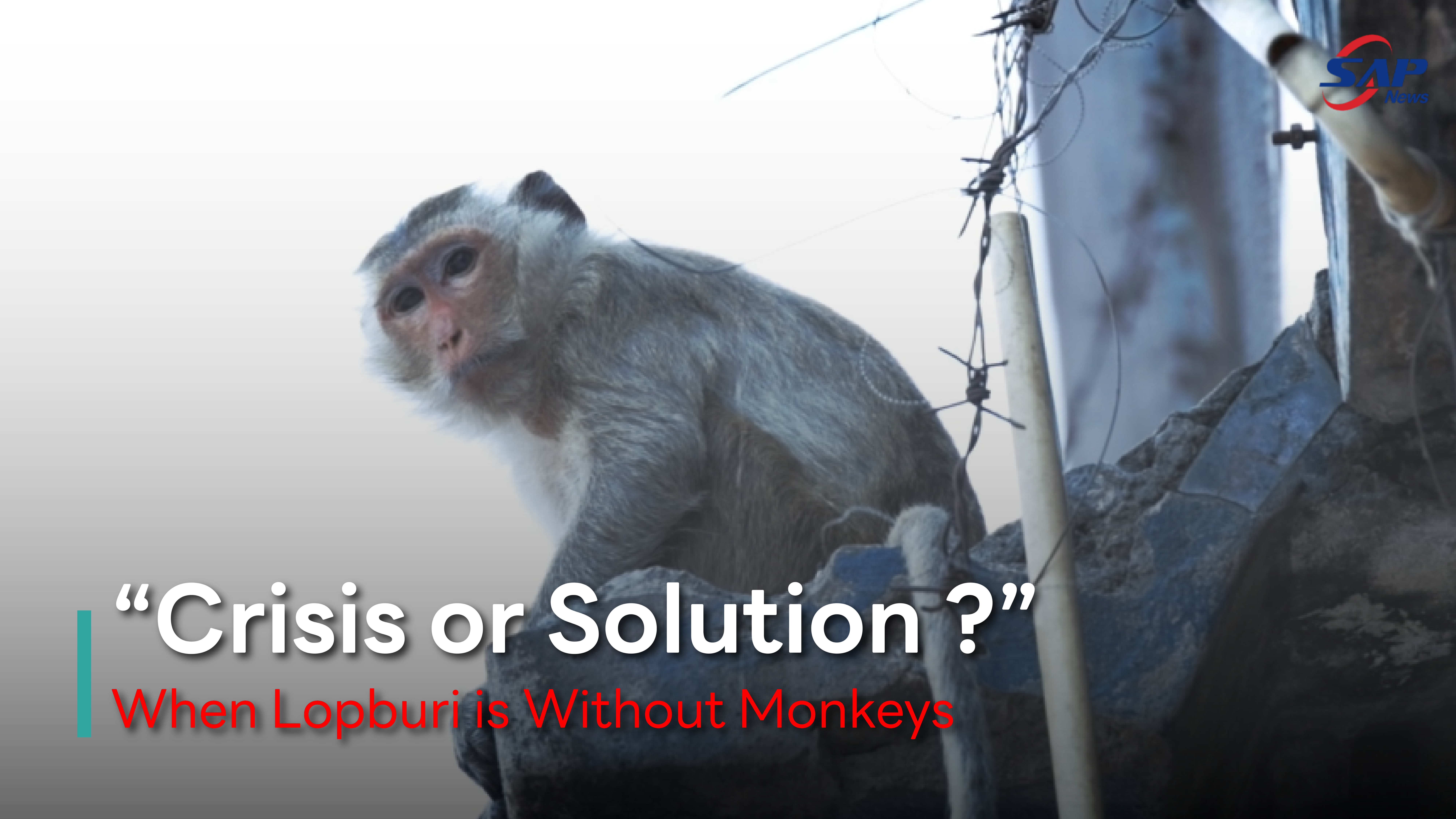
The first image that comes to mind for many is the thousands of long-tailed macaques running around Phra Prang Sam Yot (Three Pagodas in Bangkok). Some climb power lines, others jump onto tourists' cars, becoming an iconic image familiar to both Thais and foreign tourists. For decades, Lopburi monkeys have become more than just wild animals living in the city; they have become a symbol of the province, bringing both tourism fame and, at the same time, problems for locals. But today, the image of the monkeys that once filled the city is changing after the government began seriously implementing measures to capture and relocate monkeys from urban areas. The important question, therefore, is not just how many monkeys have disappeared, but rather, “A crisis or a solution when Lopburi is without monkeys?”

From Ancient Sites to the City of Monkeys
Lopburi long-tailed macaques have a long-standing connection with the city's important ancient sites, especially Phra Prang Sam Yot and San Phra Kal (Shrine of the Black Buddha). Originally, these monkeys lived naturally in the forests and around the ancient sites, which were once lush forest areas. As the city developed and became a tourist destination, many people traveled to the area. The monkeys began to adapt to humans and sought food from tourists and nearby shops, which became an important food source. The continuous food supply and increased breeding of monkeys have transformed them from wild animals living in nature into urban creatures, inhabiting the environment alongside people. At one point, the sight of monkeys roaming around Phra Prang Sam Yot became a significant symbol of Lopburi Province, leading to tourism-promoting events like the "Monkey Banquet."

Human-Animal Conflict
In recent years, the number of monkeys in Lopburi City has increased rapidly. Local estimates indicate that at one point, there were more than 2,000-3,000 monkeys living in the city. As this population grew beyond the natural balance, the monkeys' habitat expanded from the historical site into the community. Many shops had to install iron cages and netting to protect against monkeys, and houses had to keep doors and windows closed at all times because monkeys might climb in to find food. There have also been incidents of monkeys snatching food from tourists or attacking passersby. These problems have accumulated over many years, becoming a source of distress for local residents. Lopburi has seen continuous urban expansion, with houses, shops, and businesses increasing around the historical site. As the city grows, the habitats of humans and monkeys increasingly overlap. While initially confined to the historical site, these monkeys have begun to spread into markets, buildings, and business districts. Conflict between humans and monkeys has therefore increased.

Ms. Winichanan Charanthanawat, Deputy Mayor of Khao Sam Yot Municipality, commented that monkeys are a symbol of Lopburi. If the monkey population in Lopburi were at a manageable level, their welfare could be ensured, allowing them to coexist with the public without disturbing tourists.
Monkey Capture Operation
To address this problem, several agencies, including Lopburi Municipality, local administrative organizations, and the Department of National Parks, Wildlife, and Plant Conservation, have begun collaborating. One key measure is the establishment of the Pho Kao Ton Monkey Shelter, a controlled area for caring for monkeys captured from urban areas. In 2024, a serious monkey capture operation began. The first phase of the project can accommodate approximately 700-800 monkeys. Monkeys were captured from various key areas, such as the Asia Hotel, Seng Heng Restaurant, Chayowanich Restaurant, and Manorah Market. The remaining approximately 1,500 monkeys are planned for capture in subsequent phases.

Regarding the plan to relocate monkeys to the Pho Kao Ton monkey sanctuary in Mueang District, Lopburi Province, Phase 1, consisting of 3 cages, the process is as follows: Phase 1 involves capturing approximately 200 monkeys from the Asia Hotel and Seng Heng shop area to be placed in cage 3, expected to take place in April 2024. Phase 2 involves capturing approximately 300 monkeys from the front and back of the Chayowanich shop to be placed in cage 2, expected to take place in May 2024. Phase 3 involves capturing approximately 237 monkeys from the Manorah Market to be placed in cage 1, expected to take place in May 2024. In total, approximately 700-800 monkeys will be relocated to the Pho Kao Ton sanctuary in this first phase.
After being relocated to Pho Kao Ton, the monkeys appear to have gained weight due to the constant provision of food by the public. However, even though they are city monkeys, their instinct for independence and freedom, stemming from their previous roaming habits, still remains, resulting in continued reports of escapes.
A New Life for Monkeys at the Shelter
After being moved to the shelter, many monkeys are in better physical condition due to consistent feeding and ample living space. However, a significant number of monkeys still retain their independent instincts, having lived in the city for a long time. Therefore, reports of monkeys escaping from their cages still occur periodically.

Mr. Chamroen Salachip, Mayor of Lopburi, who has long overseen the monkey problem, stated that the Lopburi monkey issue has existed for 50-60 years. However, after the recent relocation of monkeys to the Rim Pho Khao Ton shelter, the area around Phra Prang Sam Yot and the city's economy have improved, with many shops opening. A small number of monkeys will remain around Phra Prang Sam Yot to serve as a memento for visitors to Lopburi. He assured us that the relocated monkeys are now happy.
Lopburi's Image Transformation
Following a decrease in the monkey population, the atmosphere in many areas has begun to change. Shops around Phra Prang Sam Yot that had closed due to monkey problems have reopened. People can now move around more freely, and tourists can stroll and photograph the historical site without worrying about monkeys snatching their belongings. Local authorities are beginning to develop new tourism strategies, including plans for a pedestrian street near Phra Prang Sam Yot and the San Phra Kal shrine, improving public spaces, and developing historical tourist attractions. The main goal is to make Lopburi a safe place for people to walk around and enjoy life. While the problem has lessened, the sight of a troop of monkeys once roaming around Phra Prang Sam Yot is fading. For some, monkeys are a problem that makes life difficult, but for many, they are a charm that sets Lopburi apart from other cities.

Meanwhile, Ms. Wilathip Salachip, mayor of Tha Sala Subdistrict, commented that life has improved since the decrease in monkeys, and residents are no longer negatively affected as in the past. She emphasized that the positive impact outweighs the negative.
The Monkey City as the Monkeys' Cries Begin
“Today, Lopburi is in a transitional period, balancing addressing long-standing problems with preserving the city's unique identity.” The city may have regained its peace, but a crucial question remains: on the day the monkeys' cries begin to fade, how will Lopburi reshape its identity? On the day when the city of monkeys may no longer be the city of monkeys?
Copywriter: Siam Associated Press (SAP) Editorial Department
Pictures: Some illustrations come from the Internet. If there is any infringement, please contact us to delete it.
Source of material: official media /online news
273/3 Ratchadaphisek Rd., Ratchadaphisek, Din Daeng, Bangkok, 10400
Email reporter@sapnewsth.com
Tel. 099 569 5964