



Air Force Chief: Thailand’s relations with the US and China aren't about "neutrality" but about maintaining balance. Thailand values both nations.

Today (12 October 2026), at 11:30 AM, at the Royal Thai Air Force Academy (Navaminda Kasatriyadhiraj), Air Chief Marshal Seksan Kantha, Commander-in-Chief of the Royal Thai Air Force (RTAF), announced his strategic vision for 2027–2028. He noted that regional conflicts pose geopolitical risks; the Russia-Ukraine war, for instance, has accelerated NATO's defense spending, significantly driving up the cost of military hardware and disrupting logistics. Furthermore, strategic vulnerabilities such as the Strait of Hormuz, the Strait of Malacca, and the Taiwan Strait exacerbate existing crises. Supply chain disruptions have compelled the government to re-evaluate self-reliance capabilities based on available resources.
Air Chief Marshal Seksan added that, simultaneously, border threats persist and are becoming increasingly complex. This includes missile systems, drones, unmanned aerial vehicles (UAVs), and electromagnetic warfare capabilities. Lessons learned from the use of force along the Thai-Cambodian border demonstrate that assessing an adversary's potential requires accounting for both conventional lethal weaponry and modern technologies; any future conflict would present greater operational challenges for our forces.
Air Chief Marshal Seksan further noted that a significant strategic impact is the expanding influence of major powers. We have witnessed the construction of an airport at "Ban Koen" in neighboring Laos, the extension of dominance over neighboring countries, and requests for cooperation from major powers—all moves aimed at protecting their interests. The challenge lies in maintaining a diplomatic-military balance in collaboration with the Ministry of Foreign Affairs and relevant state agencies to ensure Thailand’s continued development without becoming a pawn or placing the nation in a precarious position during wars or disasters.
Air Chief Marshal Seksan added that the situation in the Middle East has driven up energy prices, requiring the Air Force to adjust budget management and diversify supply chains. The goal is to build self-reliance and development capabilities, enabling the force to stand on its own feet to a significant degree. Furthermore, new forms of military threats involve the use of diverse, easily accessible technologies such as low-cost weaponry, attack drones, electromagnetic warfare, and cyberattacks—which generate high-impact consequences. As challenges arise across multiple dimensions simultaneously, the Air Force must develop both offensive and defensive capabilities. However, regional and global divisions stem from pressures exerted by major powers seeking to safeguard their interests; therefore, we must seek out and build networks of sincere allies.
“Last September, the United States announced it was the first nation to deploy space-based weaponry. The U.S. holds significant interests in space—most notably its tens of thousands of Starlink satellites, a figure projected to reach 40,000 by 2030—alongside vast resource interests. Consequently, it must protect these assets using military force in space. We are on the verge of witnessing ‘Star Wars’—actual space combat—and, before long, landings on the moon to establish colonies. Thailand must stay abreast of these developments and recognize the need to protect its own resources. Thailand operates several satellites, and the Air Force is preparing to launch the Napa-3 and Napa-4 satellites, collaborating with private sector networks to strengthen our utilization of space,” said Air Chief Marshal Seksan.
Air Chief Marshal Seksan added that regarding the pursuit of intelligence cooperation with foreign nations, the approach must be grounded in genuine partnership without succumbing to domination. Relationships with competitors should not devolve into hostility; friendships must be marked by sincerity; and even with adversaries, there must be room for mutual understanding. This is the mindset required for personnel performing duties abroad. The role requires individuals who possess knowledge, competence, and skills in military diplomacy and intelligence gathering. Future military attachés cannot simply focus on social functions and entertainment; they must be equipped with the tools to actively gather intelligence. They need to identify key locations and seek information through both direct and indirect channels, ensuring that in the event of conflict there is data available for analysis and comparison to guide correct operational decisions. They must also understand the true intentions of the opposing side.
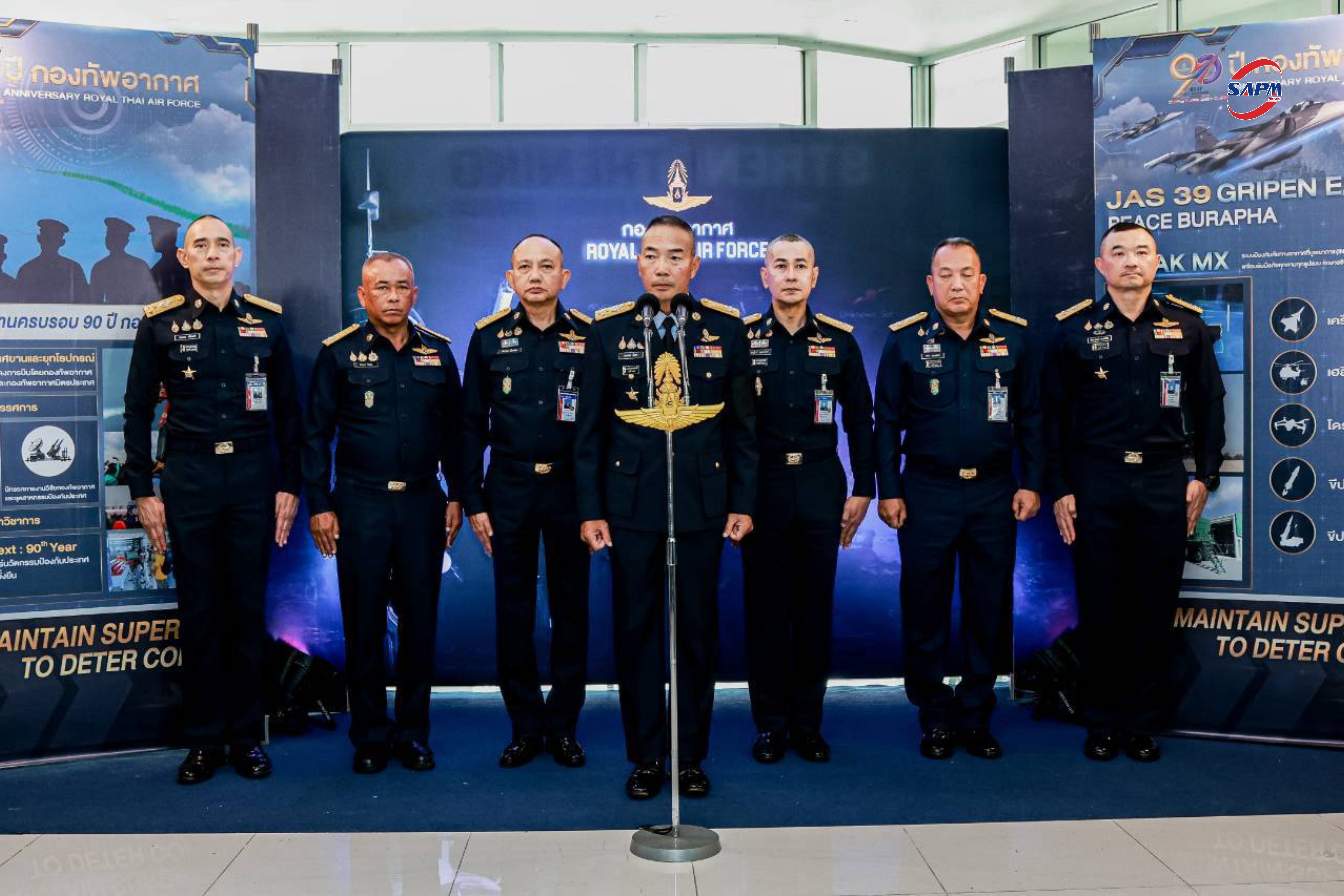
Air Chief Marshal Seksan further noted that the strategies of major powers—such as establishing airbases in neighboring countries or seeking support from Thailand—require consultation across all sectors, particularly with the Ministry of Foreign Affairs and in alignment with government policy. Thailand cannot exist in isolation, nor can it simply relocate elsewhere; therefore, engagement with neighbors is essential. This engagement occurs at various levels: countries with whom we maintain cordial relations; those with whom we can communicate but struggle to reach agreements; those with whom dialogue is necessary despite our limited bargaining power; and those that are untrustworthy and require caution. The geopolitical landscape of international relations has shifted significantly over the past 5–10 years. Since Thailand is not a major power with significant bargaining leverage, we must navigate a path that maximizes national interest grounded in mutual trust and shared benefits.
“Sometimes we must make concessions to gain something in return; at other times, we must ask for something and offer something else in exchange. We must be prepared to do this if it ultimately serves the national interest. Consequently, the military’s foreign affairs operations must align with and complement the government’s foreign policy and the Ministry of Foreign Affairs,” said Air Chief Marshal Seksan.
Air Chief Marshal Seksan added that in terms of political intent, Thailand and Laos are excellent friendly nations; Laos is a peace-loving country, though it also seeks economic development. However, economic, military, and political power often go hand in hand. Our role is to observe and monitor from the outside, analyzing the various stances that emerge. We are looking beyond just Laos; we are considering the influential major powers involved in developing airbase facilities—sites that could potentially serve economic, political, and military purposes. We will continue to monitor the situation. A “threat” is not defined solely by the possession of military hardware, but also by the intent to use it. Some nations may not possess superior weaponry, yet conflict can still arise if the intent is there—as seen in the past case involving Thailand and Cambodia.
When asked about maintaining neutrality between major powers like the US and China, Air Chief Marshal Seksan stated that “neutrality” is not the right term; rather, we aim to maintain a balance. He offered an analogy: having two powerful friends does not mean interacting with them in the exact same way; instead, we choose to engage in areas that are mutually beneficial. Decisions regarding shared interests—whether in military, economic, or political spheres—rest with the government and the nation to determine how best to maintain that balance. Thailand has no conflict with anyone, so the best approach is to maintain good relations with both sides.
Photo: Weeraphat Ratsameerueangrong
Copywriter: Siam Associated Press (SAP) Editorial Department
Pictures: Some illustrations come from the Internet. If there is any infringement, please contact us to delete it.
Source of material: official media /online news
273/3 Ratchadaphisek Rd., Ratchadaphisek, Din Daeng, Bangkok, 10400
Email reporter@sapnewsth.com
Tel. 099 569 5964