



RTAF Commander-in-Chief outlines formidable 10-year combat capability vision unveils equipment procurement plan
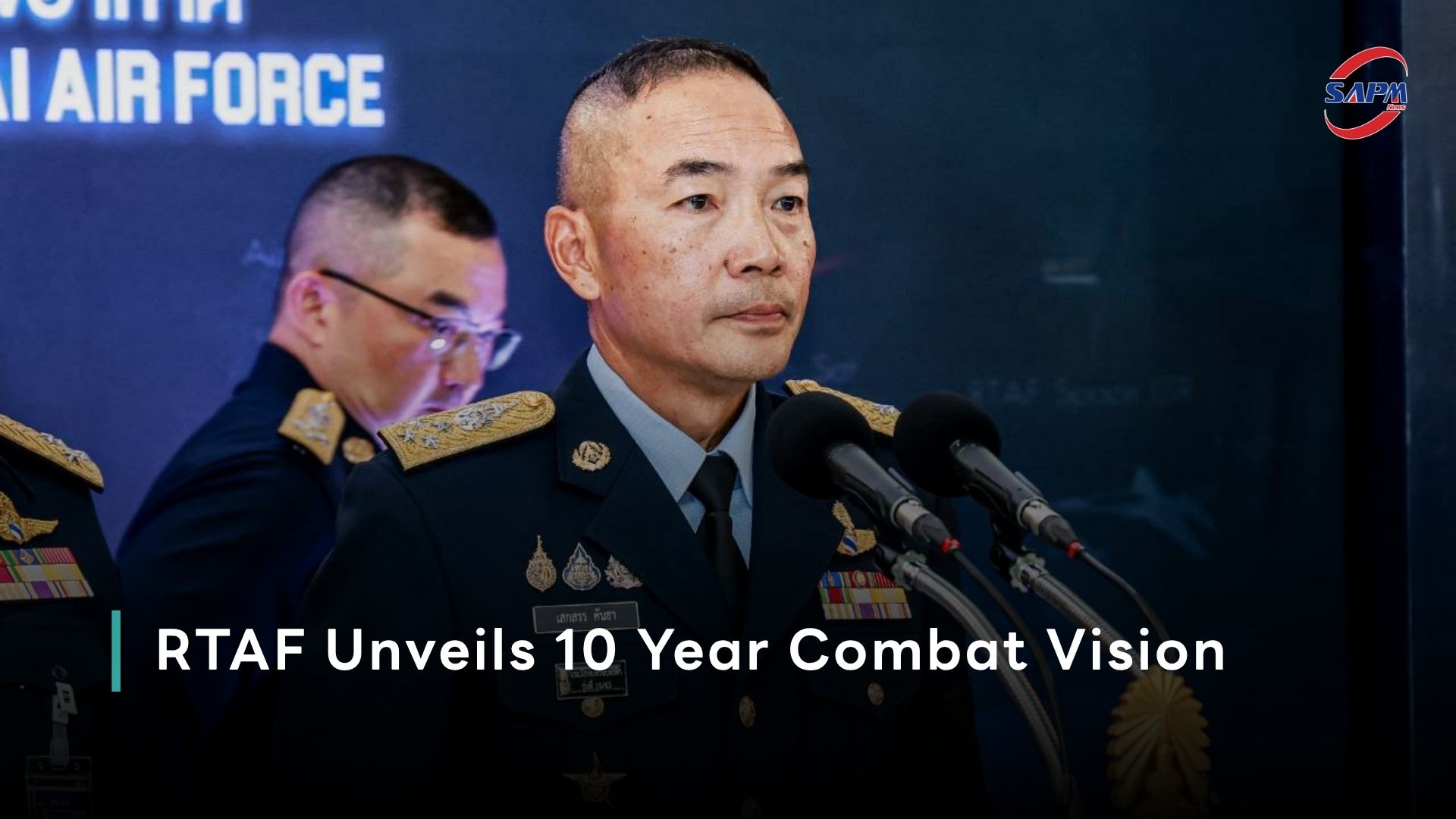
Today (12 October 2026), at 11:30 AM, at the Royal Thai Air Force Academy (Navaminda Kasatriyadhiraj), Air Chief Marshal Seksan Kantha, Commander-in-Chief of the Royal Thai Air Force (RTAF), announced his intent and vision for the years 2027–2028. Addressing the arms and equipment procurement program, he stated that the RTAF is committed to “Strengthening Air Power towards an Unbeatable Air Force.” This involves development aligned with strategy, doctrine, and the White Paper to safeguard national interests spanning both airspace and outer space as well as to protect sovereignty and the Thai people. The focus is on strengthening foundations across personnel, equipment, and technology, prioritizing quality over quantity through the implementation of various key projects and initiatives. Continuous development ensures that, over the next decade, the Air Force will comprise the following:
Group 1: Air Operations
-Fighter-Attack Aircraft Replacement Project (Phases 1 and 2)
-Strategic Unmanned Combat Aerial Vehicle (UCAV) Acquisition Project (Phase 1)
-Targeting Pod Acquisition Project (Phase 2)
-Precision-Guided Munitions Acquisition
-Supersonic Stand-Off Weapon Acquisition
-Long-Range Precision Weapon Acquisition
Group 2: Command, Control, and Air Defense
-Air Defense System Development and Upgrade Project (D2C2)
-Airborne Command and Early Warning Capability Development
-Air Force Base Air Defense System (IADS) Development Project (Phases 1 and 2)
Group 3: Detection Systems
-Real-time ISR Capability Development using Artificial Intelligence (AI-Assisted)
-Air Defense System Development and Upgrade Project – Phase 11 (Hat Yai Air Defense Station)
-Air Defense System Development and Upgrade Project – Phase 12 (Phuket Air Defense Station)
-Space Operations Development Project (Satellite)
Group 4: Air Transport
-Multi-role Tactical Transport Aircraft Acquisition Project (Phase 1)
-VIP Transport Aircraft Acquisition (Replacement for Transport Aircraft Type 19)
-Medium-sized VIP Transport Helicopter Acquisition
-VIP Transport Helicopter Acquisition
Group 5: Readiness Maintenance and Research & Development
-Logistics capability development project for the Multi-Role Fighter Aircraft (Gripen 39 C/D) – Phase 2
-Tactical Simulator Center procurement project
-Tactical-level armed Unmanned Aerial Vehicle (UAV) research and development project
Group 6: Public assistance and morale building
-Royal Rainmaking mission aircraft modification project (BT-67)
-Personnel housing construction project
-Stupa construction project for enshrining Buddha relics
-Recreational area development for personnel and their families

Air Chief Marshal Seksan further stated that regarding technology-based military hardware, quality must take precedence over quantity, though the quantity must still be appropriate. We will emphasize precision, beyond-visual-range and long-range capabilities, as well as high destructive power that commands awe and instills fear. If an enemy realizes that a weapon launched from a hundred kilometers away can pass through a window or doorway opening of less than one meter, they ought to be terrified. We are ready to apply technology to maximize efficiency. Furthermore, regarding operations, we must review and refine our doctrine, integrate technological capabilities, and elevate the Air Force's training standards. This includes the management, control, and defense against unmanned aircraft a task assigned to us by the government specifically for protecting critical installations such as airbases, air wings, the Flying Training School, the Nam Phong Training Center, Task Force 9, and the Air Warfare Center. It will serve as a centralized hub for air combat tactics and systematic combat readiness.
Air Chief Marshal Seksan further stated that combat command and control must align with the Royal Thai Armed Forces' "One Team" approach, given the importance placed on joint operations. Efforts will be made to upgrade the capabilities of the Air Force Operations Center and enhance air operations, cyber defense, and electronic warfare capabilities. Additionally, early warning and air defense systems will be improved to effectively detect and counter threats such as drones and ballistic missiles.
“In the next 10 years marking the Air Force's centennial the force will become more compact. We will maintain main airbases for three primary combat wings: Wing 1, Wing 4, and Wing 7. The remaining wings will focus on special missions and transport. There will be an increased reliance on Unmanned Aerial Vehicles (UAVs), with manned and unmanned aircraft operating jointly through integrated technology. We will possess high-capability helicopter squadrons and ground units capable of target designation and coordinating joint strategies between air and other military forces. We are committed to developing a robust network.” Air Chief Marshal Seksan said.
Regarding the procurement of the Barak MX a modular, multi-purpose air defense and missile system Air Chief Marshal Seksan noted that it represents a significant advancement in military hardware. This system has the potential to transform the Air Force's air defense capabilities; therefore, its quality is unquestionable. However, the quantity must be sufficient, and planning for further development in Phase 2 is required. The package must include technology transfer and training, as well as infrastructure development, to ensure confidence in our airspace defense—guaranteeing that critical areas remain protected against threats or wartime attacks. Delivery of the units procured in the initial phase is expected in 2029.
Copywriter: Siam Associated Press (SAP) Editorial Department
Pictures: Some illustrations come from the Internet. If there is any infringement, please contact us to delete it.
Source of material: official media /online news
273/3 Ratchadaphisek Rd., Ratchadaphisek, Din Daeng, Bangkok, 10400
Email reporter@sapnewsth.com
Tel. 099 569 5964