



“Phonpee” asserts “People’s Solar Project” does not favor large corporations
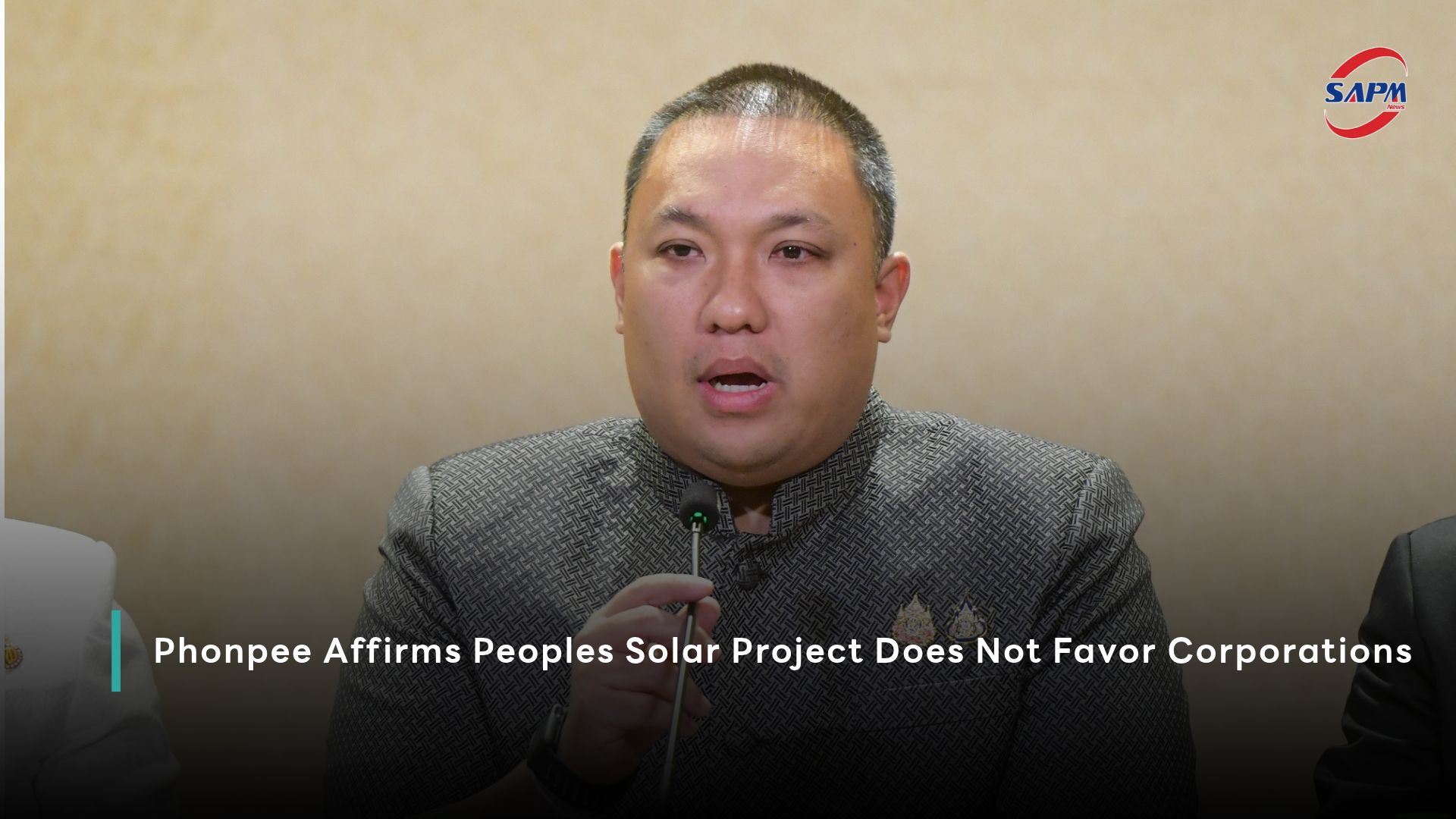
Today (28 October 2026) at 2:00 PM at the Government Press Center, Naree Samosorn Building, Government House, Mr. Phonpee Suwannachawi, Deputy Minister of Interior, addressed the “People’s Solar Project” following criticism that it favors large private companies. He clarified that the initiative aims to enable citizens to generate their own electricity using their own rooftops a vital measure given the current energy situation, which remains beyond the government’s direct control. The government will provide a 50,000-baht subsidy per household for the installation of a 5–10 kilowatt solar system, with the option to sell any surplus electricity back to the state. Furthermore, all solar panels must meet strict quality standards, ensuring a lifespan of 20–25 years. For those lacking the necessary capital, low-interest loan options are available through three participating banks.
In response to concerns that the project might benefit large private corporations, Phonpee stated that such claims are unfounded. He explained that the project requires citizens to select their own service providers from an official “Vendor List.” Consequently, any solar installation company wishing to serve the public must first undergo a rigorous evaluation to ensure they meet the required standards. Both the Metropolitan Electricity Authority (MEA) and the Provincial Electricity Authority (PEA) conduct thorough evaluations of companies assessing their financial status, engineering capabilities, and past performance to determine the scale of service they are qualified to provide. For instance, if a company is deemed capable of serving five households, it must complete work for those five households first before expanding to another five. A company cannot claim a capacity for five households while attempting to undertake projects for 100.
Regarding the requirement for operators to provide a 50,000-baht guarantee per household installation, Mr. Phonpee clarified the process: once a service is completed, the operator notifies the relevant electricity authority. The authority then dispatches personnel to inspect the installation and electrical connections, and to replace the meter with one capable of recording electricity purchased from the household. Once the system is successfully connected and operational, the 50,000-baht guarantee is returned to the operator within seven days contrary to reports suggesting the funds would be held for six to seven months. The objective of this guarantee is to prevent operators from abandoning their projects.
Addressing allegations that the policy favors large corporations specifically regarding a 10,000-baht security deposit held for seven years Mr. Phonpee explained that this is linked to the low-interest bank loans available to households, which span a seven-year term. As the government is committed to supporting citizens across all aspects, it requires installers to provide a seven-year guarantee to the public, covering the maintenance of solar panels and the inspection of all electrical system components. All of this must be completed within a seven-year timeframe. The government’s concern is that a private operator might install the equipment and then disappear closing down their company leaving the public with faulty or damaged equipment. Therefore, these funds are earmarked to ensure the public remains supported.
“I want to emphasize that this project was not designed for the benefit of any single private company. Our goal is to help the public reduce their electricity costs and empower them to own small-scale power generation systems for their own use, while also providing an opportunity to generate additional income. Looking back at the past, no previous government has ever taken such an initiative for the people. In earlier solar power projects, private operators received 'adder' payments resulting in higher electricity costs where the profit margin simply went to them. Today, we want to break that cycle because we intend to return the benefits directly to the people. This is a project the government is genuinely committed to, aimed at lowering expenses for the public. Even those who do not consume electricity during the day can participate; by installing these systems, they can earn supplementary income during the hours when their electricity consumption is low” Mr. Phonpee said
When asked whether a guarantor would be required for bank loans, Mr. Phonpee explained that the electricity authority would simply review the applicant’s electricity payment history over the preceding 12 months. Regarding the negative reports and questions that emerged as soon as the project was launched, Mr. Phonpee noted that this is actually a positive development. It allows us as the architects of this policy to address any concerns or doubts raised about certain installers, providing clarity to the public. Notably, the general public the households themselves have not raised such questions; in fact, it is heartening to see that the people seem to recognize the government’s sincere intention to act in their best interest. Aiming to help the public reduce their expenses,
Mr. Phonpee emphasized that 56,000 households have already applied to join the program 44,000 through the Provincial Electricity Authority (PEA) and 12,000 through the Metropolitan Electricity Authority (MEA). Interested individuals can apply online or visit their nearest local electricity office with just their national ID card. Three state-owned banks the Government Housing Bank (GHB), the Government Savings Bank (GSB), and the Bank for Agriculture and Agricultural Cooperatives (BAAC) are providing support through loans with a special fixed interest rate of 2.5% for 7 years, with monthly installments of only 1,200 baht. Eligibility is based on a good electricity bill payment history specifically, no outstanding payments over the past 12 months and no collateral is required. Furthermore, participants can earn income by selling excess electricity back to the utility provider at a rate of 2.20 baht per unit. Once the 7-year loan is fully repaid, participants will continue to benefit from electricity savings and income from selling surplus power for the remainder of the solar panels' operational lifespan over 20 additional years.
Copywriter: Siam Associated Press (SAP) Editorial Department
Pictures: Some illustrations come from the Internet. If there is any infringement, please contact us to delete it.
Source of material: official media /online news
273/3 Ratchadaphisek Rd., Ratchadaphisek, Din Daeng, Bangkok, 10400
Email reporter@sapnewsth.com
Tel. 099 569 5964