



People's Party shadow cabinet presses for migrant labor management reform, slamming government for letting Myanmar military double-tax and collect CI center kickbacks, humiliating Thailand
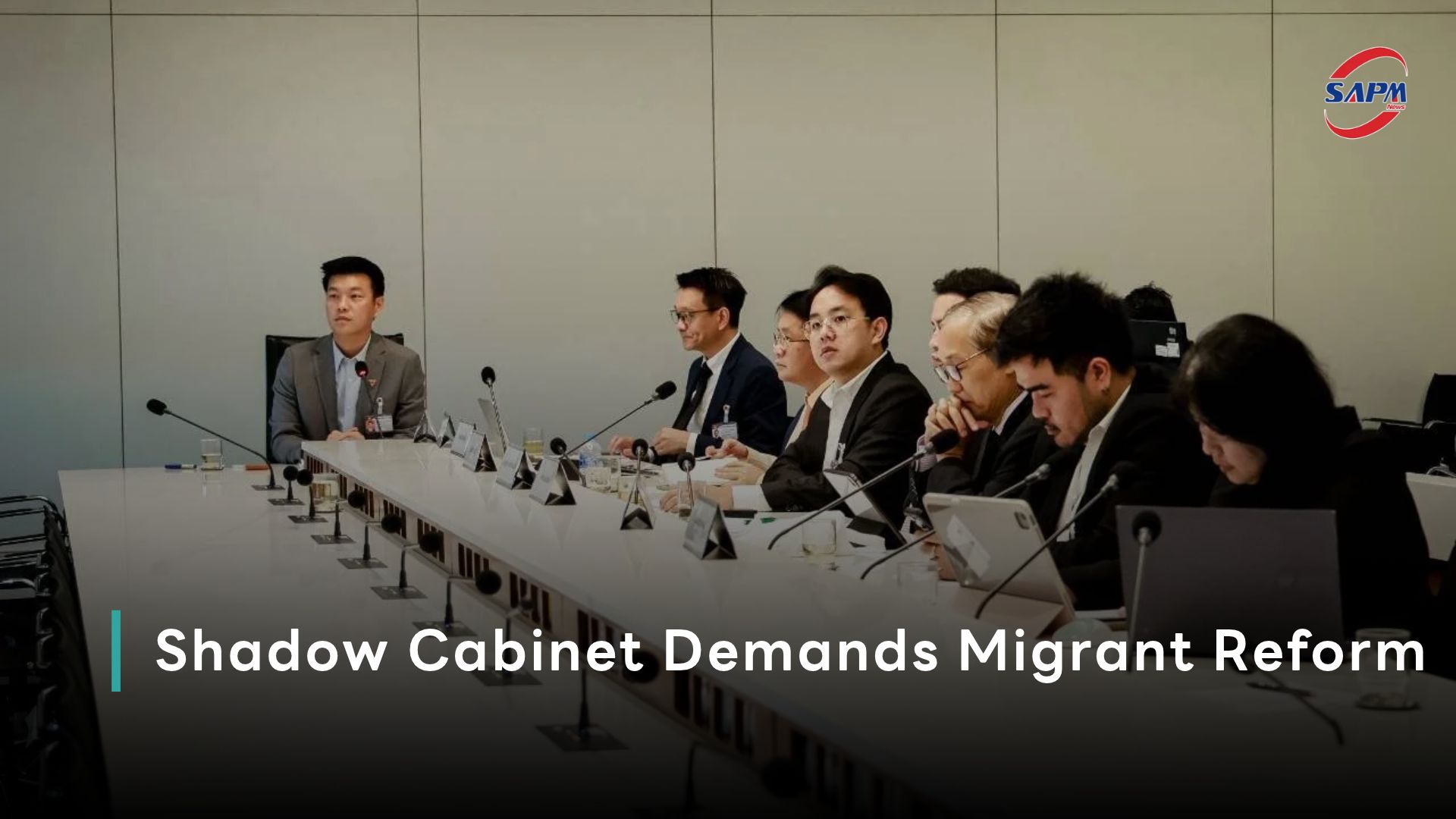
Today (2 November 2026) at 10:00 AM at Parliament, Natthaphong Ruengpanyawut, Party-List MP and Leader of the People's Party, delivered a press conference following the shadow cabinet meeting on migrant labor management. He condemned the violence against leaders of a migrant worker demonstration in front of the UN office on Ratchadamnoen Nok Avenue, emphasizing that as long as we believe in the rule of law and democracy, physical assault is entirely unacceptable regardless of differing political views.
Natthaphong outlined the People's Party's position on migrant labor management based on three key facts: 1) It is undeniable that migrant workers are essential to the Thai economy and business operators; 2) It is undeniable that labor management suffers from leakages and corruption, particularly at Certificate of Identity (CI) centers, where government neglect allows foreign governments to exploit migrant workers within Thai borders, potentially violating Thailand's sovereignty; and 3) It is undeniable that these internal leakages negatively affect everyone, including Thai workers, Thai employers, and migrant workers themselves.

The People's Party leader noted that the primary objective is ensuring migrant workers receive equal fundamental human rights protection, accompanied by measures to upskill both Thai workers and business operators, ensure fair wages, and maintain safe, standardized working conditions free from oppression, forced labor, and human trafficking. These actions align with international standards and Thailand's goal of joining the OECD. To achieve this, the government must: 1) Create a clear and accurate database of migrant workers; 2) Review and update the list of reserved occupations, utilizing Thai workers primarily for non-shortage fields while easing restrictions for migrant labor in shortage sectors; and 3) Establish mechanisms to help migrant workers adapt to Thai language, culture, and way of life to prevent future conflicts.
Nilubon Pongpayom, representing the White Employers Group, disclosed that costs for registering Myanmar workers have surged unnaturally. Passport fees originally set at 310 baht rose to 710 baht and recently jumped to 2,670 baht. Upon inquiring with the Department of Employment and the House Standing Committee on National Security, it was revealed that the increase stemmed from additional taxes imposed by Myanmar authorities, which were included in payment receipts without explanation. She argued that since these workers already pay taxes in Thailand, double taxation should not occur. Furthermore, even after paying fees, employers and workers visiting CI centers face middlemen demanding bribe fees for “ghost queues” ranging from 1,350 to 1,500 baht to gain entry. Inside, workers are further coerced into paying an additional 2% of their estimated income (around 6,000 baht per person), purportedly sent to the Myanmar military government via TrueMoney transfers to be paid at 7-Eleven stores. Employers often have to advance these funds despite facing flood-related financial strains. With roughly 700,000 workers needing CI certificates and over 1 million passports nearing expiration, failing to address these forced costs will push workers to leave, worsening severe labor shortages.

Sahasawat Khumkhong, Chonburi MP from the People's Party, pointed out that migrant labor registration should adhere to three core principles: simple, fast, and cheap. Instead, Thailand's process is slow, difficult, and expensive, burdened by hidden costs that breed corruption and hide true migrant worker numbers. He questioned whether permitting double taxes and queue bribes at CI centers amounts to facilitating revenue collection for the Myanmar military on Thai soil, asserting that the Ministry of Labor cannot dodge responsibility. Short-term, he proposed reforming CI centers so the Thai government maintains oversight, upholding the rule that taxes belong to the country where work is performed. Medium-term, the government should consider eliminating CI centers by reviving unilateral identity collection and registration. Long-term, comprehensive legislative reform is needed for laws like the Immigration Act and the Royal Decree on Managing the Work of Aliens.

Phisal Manawapat stated that these issues stem from Thailand's deferential diplomatic posture toward Myanmar's military leadership, which compromises national dignity and interests while burdening Thai citizens. Given that the Myanmar military ignores Thailand and ASEAN's 5-Point Consensus—even dropping bombs near the Thai border—the shadow cabinet submitted 5 recommendations: 1) Prioritize the economic benefits Thailand receives from legal workers over the interests of the Myanmar military regime; 2) Formally notify Myanmar that its 2% income tax collection on workers in Thailand violates international law and the 2002 Thailand-Myanmar Double Taxation Agreement; 3) Provide temporary identity document leniency to reduce employer costs and public hospital burdens caused by undocumented workers; 4) Re-evaluate gradual diplomatic approaches that undermine Thailand's dignity; and 5) Address direct impacts on Thailand—such as spillover shelling, narcotics, and river contamination—by targeting the root cause: the protracted war between the Myanmar military and ethnic armed groups.

Photo : Weeraphat Ratsameerueangrong
Copywriter: Siam Associated Press (SAP) Editorial Department
Pictures: Some illustrations come from the Internet. If there is any infringement, please contact us to delete it.
Source of material: official media /online news
273/3 Ratchadaphisek Rd., Ratchadaphisek, Din Daeng, Bangkok, 10400
Email reporter@sapnewsth.com
Tel. 099 569 5964