



“Scammers” A test for the government – Driving human security forward

Assoc. Prof. Sipim Sornbanlang, lecturer at the Political Science Major, Faculty of Social Sciences, Srinakharinwirot University/ Photo: Chayanan Deekaew via SAP NEWS
SAP News had the opportunity to interview with Assoc. Prof. Dr. Sipim Sornbanlang, lecturer at the Department of Political Science, Faculty of Social Sciences, Srinakharinwirot University, on the topic “Thailand’s Management of the Scammer Problem.” The discussion took place amid growing international crackdowns on scam operations, which have been increasingly exposed as extending beyond fraud to include human trafficking and forced labor.
Public Outrage and Pressure on the Government
Assoc. Prof. Dr. Sipim stated that “the scammer problem affects Thai people of all ages and will become a pressure point for the government, since everyone is a victim, whether through fraudulent investments or romance scams. The widespread impact on citizens will inevitably pressure the government to implement more concrete and decisive solutions.”
Thailand’s Role as a Global Leader in Combating Scammers
Dr. Sipim believes that Thailand can play a leading role in suppressing scam networks.
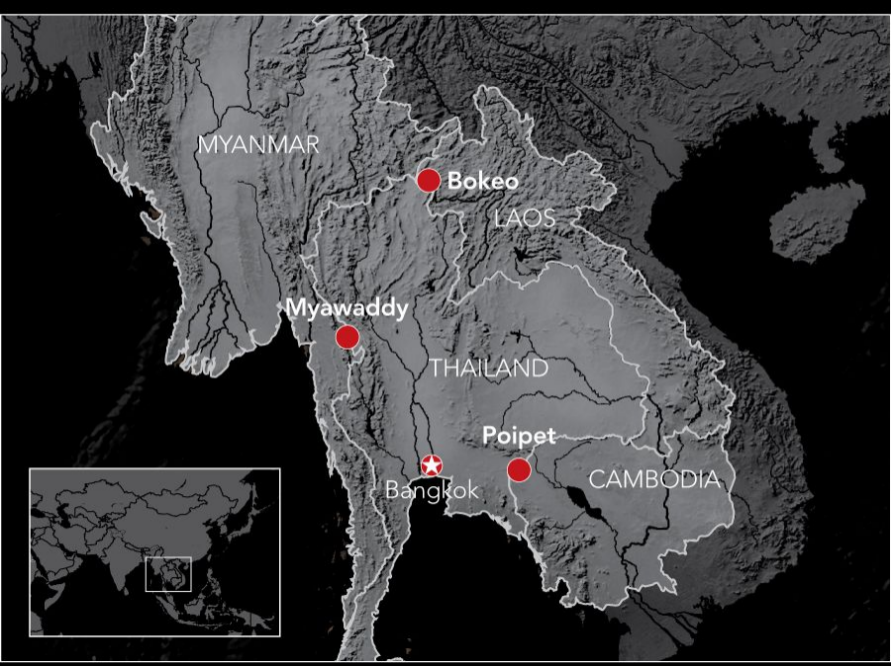
The map shows Thailand’s geopolitics in the center of the scammer’s countries which is Cambodia, Myanmar, and Laos./ Photo: Shortandstories
“Thailand is in a strategically important geopolitical position, surrounded by countries that have become scammer bases. This is partly because Thailand has one of the strongest and fastest internet infrastructures in the region. If these countries use Thailand’s internet resources to enhance their scam capabilities, Thailand can take the lead by cutting off access, such as revoking internet services, which would cripple scam networks’ ability to reach victims.”
Beyond restricting internet access, Dr. Sipim added, “The scammer problem represents a new type of transnational threat brought about by globalization, one without borders. Therefore, every nation must recognize this as a common threat and work together to formulate tangible joint solutions. Thailand can take the lead in diplomatic negotiations within the region to achieve that.”
“Scammers as a National Agenda” – But What Are the Measures?

Photo: Annie via SAP NEWS
“The Thai government has shown determination by declaring the scammer issue a national agenda,” Dr. Sipim said. “However, stronger and clearer action will be the real test of whether the government can meet public expectations. Since this problem affects everyone, failure to act decisively will ultimately backfire on the government itself.”
She emphasized that, “Given the limited timeframe of this administration, the government must act swiftly and decisively to demonstrate genuine intent to tackle scammers. This will also serve as a benchmark to show that no vested interests within or linked to the government are involved in scam networks.”
Palang Pracharath Party’s Six Proposals – Are They Enough?

Mr. Thirachai Phuvanatnaranubala as one of the representatives from Palang Pracharath Party proposed 6 measures to the government in order to suppress the Scammers./ Photo: Chayanan Deekaew via SAP NEWS
On October 22, 2025, representatives from the Palang Pracharath Party proposed six measures to combat scam networks:
1.) Cutting off electricity, internet, and fuel supplies directly and indirectly.
2.) Suspending gold trading with Cambodia.
3.) Restricting the entry and exit of individuals connected to scam networks.
4.) Freezing assets of persons linked to scam operations.
5.) Halting transactions from Thai banks.
6.) Systematically auditing financial accounts.
Dr. Sipim commented that “these are solid and useful measures that should be implemented in suppressing scam gangs. However, long-term positive impact will depend heavily on intergovernmental cooperation, which is essential for sustainable solutions.”
Thailand’s Readiness for International Cooperation

Mr. Wiroj Lakkhanaadisorn, MP from People’s Party, urged the government to declare the Scammers suppressing’ measure both domestic and international./ Photo: Chayanan Deekaew via SAP NEWS
On October 22, 2025, Mr. Wiroj Lakkhanaadisorn, MP from the People’s Party, stated that the government must clarify two key issues to both Thai citizens and the international community:
1.) Its concrete national-level anti-scam measures
2.) Its readiness to cooperate with international organizations and allied nations in tackling online crime.
This aligns with Dr. Sipim’s view that “international cooperation is the key mechanism for achieving sustainable solutions. Diplomatic efforts, both bilateral and multilateral, will be crucial to establish clear, joint operational frameworks and prevent further escalation.”
Challenges and Obstacles in Combating Scams
Drawing lessons from South Korea, Dr. Sipim pointed out that Korea has adopted clear and multi-layered approaches, such as the “Code Black” travel ban to Cambodia, and an extradition treaty between South Korea and Cambodia, both of which strengthen enforcement.
“In Thailand’s case,” she explained, “the lack of a formal extradition agreement is a major limitation in handling scam-related crimes. Learning from Korea’s experience shows that legal cooperation is essential. Thailand may need to begin with an MOU and eventually move toward a formal extradition treaty.”
Another challenge, she added, lies in human security, “South Korea’s nationalism is deeply people-centered. When Korean citizens fall victim abroad, the government sees that as a matter of national sovereignty. This reflects how Korea links state security with human security, focusing on human rights and civic protection. Thailand can learn from this model.”

Photo: Chayanan Deekaew via SAP NEWS
Vested Interests and Thailand’s Global Image
Dr. Sipim observed that “Thailand is now back on the global political radar. This presents an opportunity to clarify and counter suspicions about whether scam networks are linked to domestic vested interests, and to show the world that Thailand is committed to tackling new forms of transnational threats, especially cybercrime that harms citizens and human security.”
She added that “in Thailand, state security and human security have long been treated as separate issues. For credibility both at home and abroad, the government must promote both in parallel to achieve holistic national stability. This should be Thailand’s ultimate goal for improving its global standing.”

Korean detainees were deported to South Korea and faced legal actions./ Photo:Reuters
Lessons from South Korea – Can Thailand Follow?
“The key issue is that Thailand and Cambodia currently lack an extradition agreement. Drafting such legislation will take time,” Dr. Sipim noted.
“Given the government’s time constraints, a short-term framework or MOU for joint operations could serve as the starting point for long-term solutions, to be continued by future administrations.”
The Scammer Problem: A Time Bomb for the Government
Finally, Dr. Sipim warned, “Whatever the circumstances, the government must prove to the public that it takes this issue seriously. Failure to act decisively will show a lack of genuine concern for citizens. This problem doesn’t just affect Thais; it has wider implications for the regional economy and international relations.”
“Previous governments have also made efforts to address this issue, though progress has been inconsistent due to political transitions. If the current administration wants to make the most of its limited time, it must prioritize the people’s interests and strive to eliminate or minimize this new form of threat, because that is the essence of human security.”
Copywriter: Siam Associated Press (SAP) Editorial Department
Pictures: Some illustrations come from the Internet. If there is any infringement, please contact us to delete it.
Source of material: official media /online news
Copywriter: Siam Associated Press (SAP) Editorial Department
Pictures: Some illustrations come from the Internet. If there is any infringement, please contact us to delete it.
Source of material: official media /online news
273/3 Ratchadaphisek Rd., Ratchadaphisek, Din Daeng, Bangkok, 10400
Email reporter@sapnewsth.com
Tel. 099 569 5964