



KK Park Scammers Flee Across Moei River as Chaos Erupts – Thai Scholar Warns of “Structural Failure” in Security System
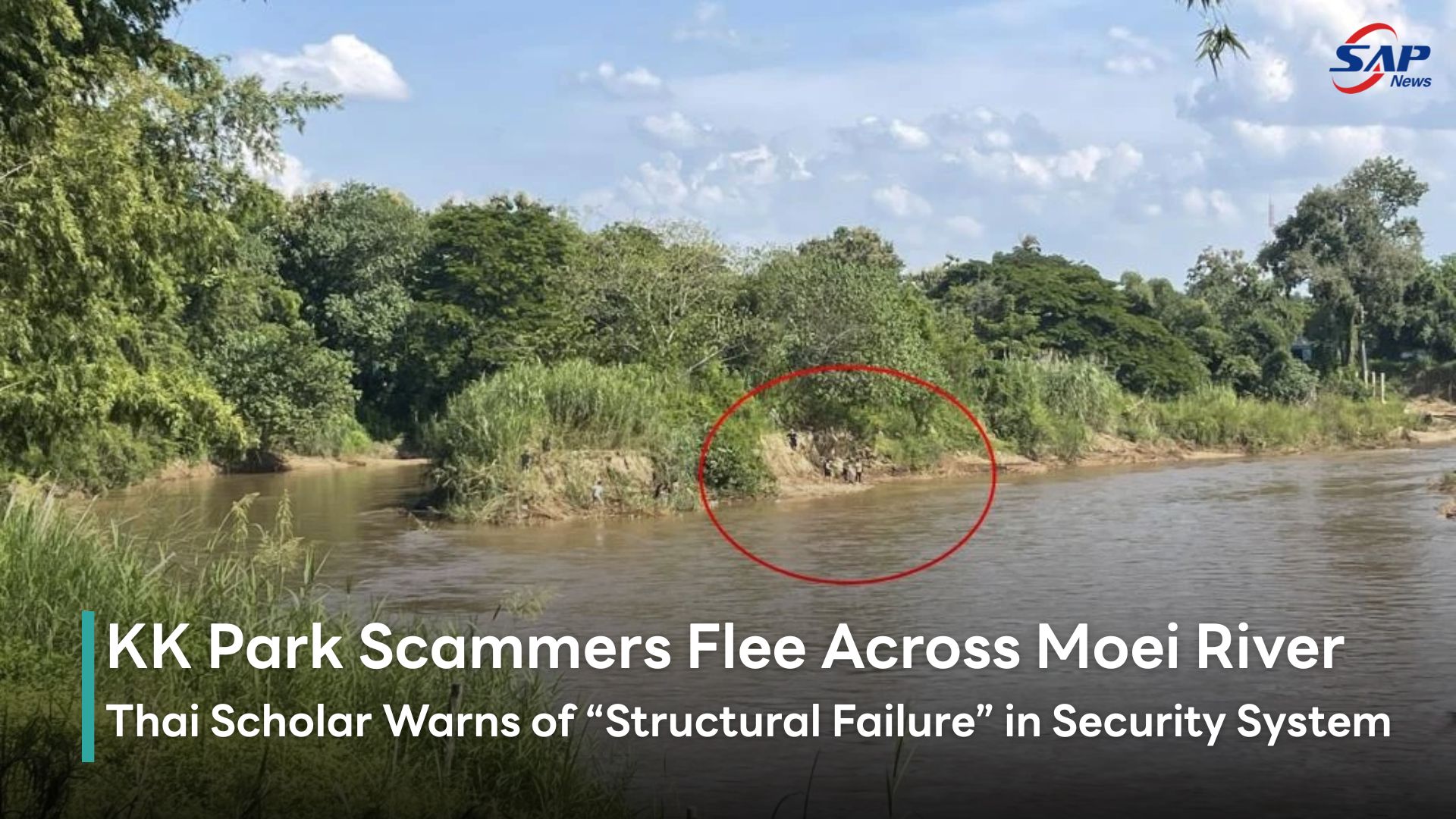
On October 22, 2025, chaos erupted at KK Park, a major scam hub in Myawaddy, Kayin State, Myanmar, located directly opposite Mae Sot District, Tak Province, Thailand. The turmoil began when the Myanmar military launched a crackdown operation on large-scale online scam syndicates operating in the area. Explosions and plumes of smoke were reported around 6 p.m., prompting hundreds of foreign nationals, including Chinese, Indian, Vietnamese, South African, Indonesian, and Pakistani citizens,
to flee for their lives, fearing arrest by Myanmar soldiers who had surrounded the compound.
As the operation intensified, many scammers and associated Thai nationals attempted to cross the Moei River into Mae Sot. The crossing was perilous, some waded through chest-deep, fast-moving waters, while others clung to foam boxes to stay afloat. The river, about two meters deep, swept several individuals away, with reports of Chinese nationals drowning. By 7 a.m. on October 23, Thai authorities had detained 677 people (618 men and 59 women), with a total of 795 individuals screened, and estimates suggesting that nearly 2,000 people had crossed into Thailand.
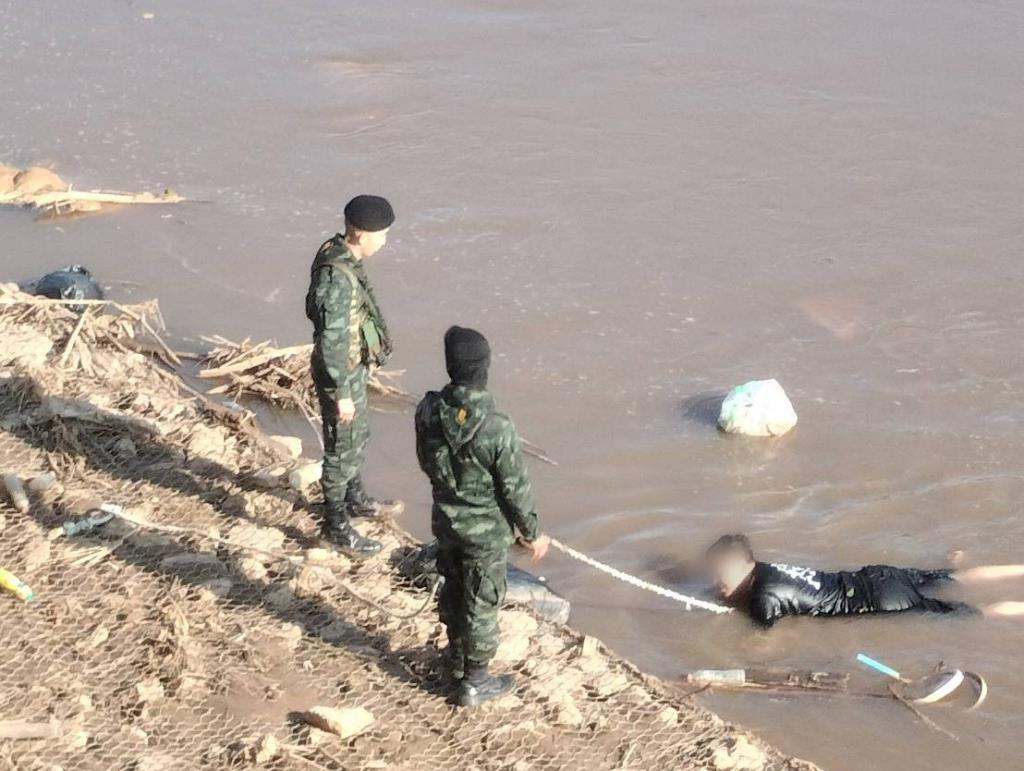
Sources in the area confirmed that the escapees came from multiple nationalities, and that some remained on the Myanmar side within territories controlled by Karen armed groups, the BGF and KNU. These forces reportedly allowed the fugitives to cross into Thailand freely. One survivor, a 26-year-old Thai-Vietnamese woman, revealed that she had been tricked by a friend into working as an “entertainer”, only to be forced to scam European and Middle Eastern victims. “I survived because the Karen soldiers stormed in and dropped me by the Moei River,” she said.
During inspections, Thai officials discovered over 4 million baht in cash among the detainees. One man, Lu Liang (33), carried 2,626,850 baht in a black backpack, while Chen He (around 60) held 564,990 baht. Both were charged with illegal entry and failure to declare foreign currency exceeding legal limits. Six other Chinese nationals carrying less than 450,000 baht each were charged solely with illegal entry.
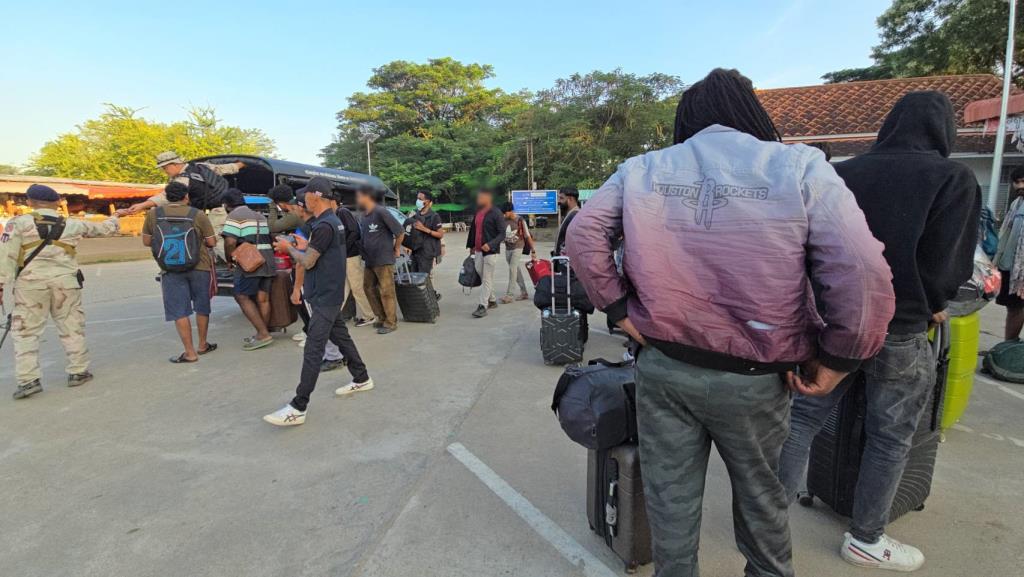
Thai authorities have since distributed detainees to Border Patrol Police Company 346, Mae Sot Police Station, and the Second Thai-Myanmar Friendship Bridge checkpoint. They are being screened for possible human trafficking victim status. Those identified as victims will enter Thailand’s National Referral Mechanism (NRM), while others will face deportation under immigration law. With more fugitives expected, security forces have prepared additional detention facilities at local volunteer defense units and educational centers. The Royal Thai Army reaffirmed that all actions are conducted in accordance with law and humanitarian principles.
Meanwhile, SpaceX, owned by Elon Musk, announced the termination of 2,500 Starlink satellite internet devices in Myanmar after discovering their use by scam syndicates. Myanmar troops reportedly seized over 30 Starlink units at KK Park. Jay Kittiya, a civil society coordinator, urged the Thai Prime Minister to mobilize central agencies to cooperate with NGOs and the UNHCR in expediting the lengthy victim identification process and targeting the transnational crime masterminds behind the operations

Photo: The Matter
On October 24, 2025, in a related development, Assoc. Prof. Dr. Lalita Harnwong, lecturer at the Department of History, Faculty of Social Sciences, Kasetsart University, warned that the KK Park incident emphasizes a “structural failure” in Thailand’s border security system. She emphasized that without a systemic mindset shift, government responses will continue to be “temporary patchwork fixes.”
Dr. Lalita identified three root causes
1.) Disjointed coordination among security agencies, compounded by conflicts of interest that weaken border enforcement.
2.) A rigid bureaucratic mindset that views issues linearly, allowing suspicious cross-border goods, such as Starlink devices, to pass unchecked.
3.) A narrow official mindset that refrains from investigating individuals with valid passports, even when their activities raise suspicion.
For sustainable solutions, she proposed four key strategies
1.) Intensive screening and mindset reform among officers to prevent suspected scammers from returning to work across the border.
2.) Establish a “Combat Force Inventory Mapping” to identify Thai enablers who sustain scam centers in Myanmar.
3.) Formulate a clear Myanmar engagement strategy, leveraging relationships with Karen leaders.
4.) Implement a “Bullet Path Strategy”, in which cabinet ministers directly engage with Chinese criminal groups in Myanmar to apply diplomatic and economic pressure.
Dr. Lalita concluded by urging swift and decisive action, with coordinated efforts among the army, police, immigration, and customs to create a unified, proactive system rather than “prolonging the illness” through fragmented, reactive policies.
Copywriter: Siam Associated Press (SAP) Editorial Department
Pictures: Some illustrations come from the Internet. If there is any infringement, please contact us to delete it.
Source of material: official media /online news
Copywriter: Siam Associated Press (SAP) Editorial Department
Pictures: Some illustrations come from the Internet. If there is any infringement, please contact us to delete it.
Source of material: official media /online news
273/3 Ratchadaphisek Rd., Ratchadaphisek, Din Daeng, Bangkok, 10400
Email reporter@sapnewsth.com
Tel. 099 569 5964