



Truck Carrying Research Monkeys Overturns in Mississippi — Five Shot Dead Amid Virus Fears
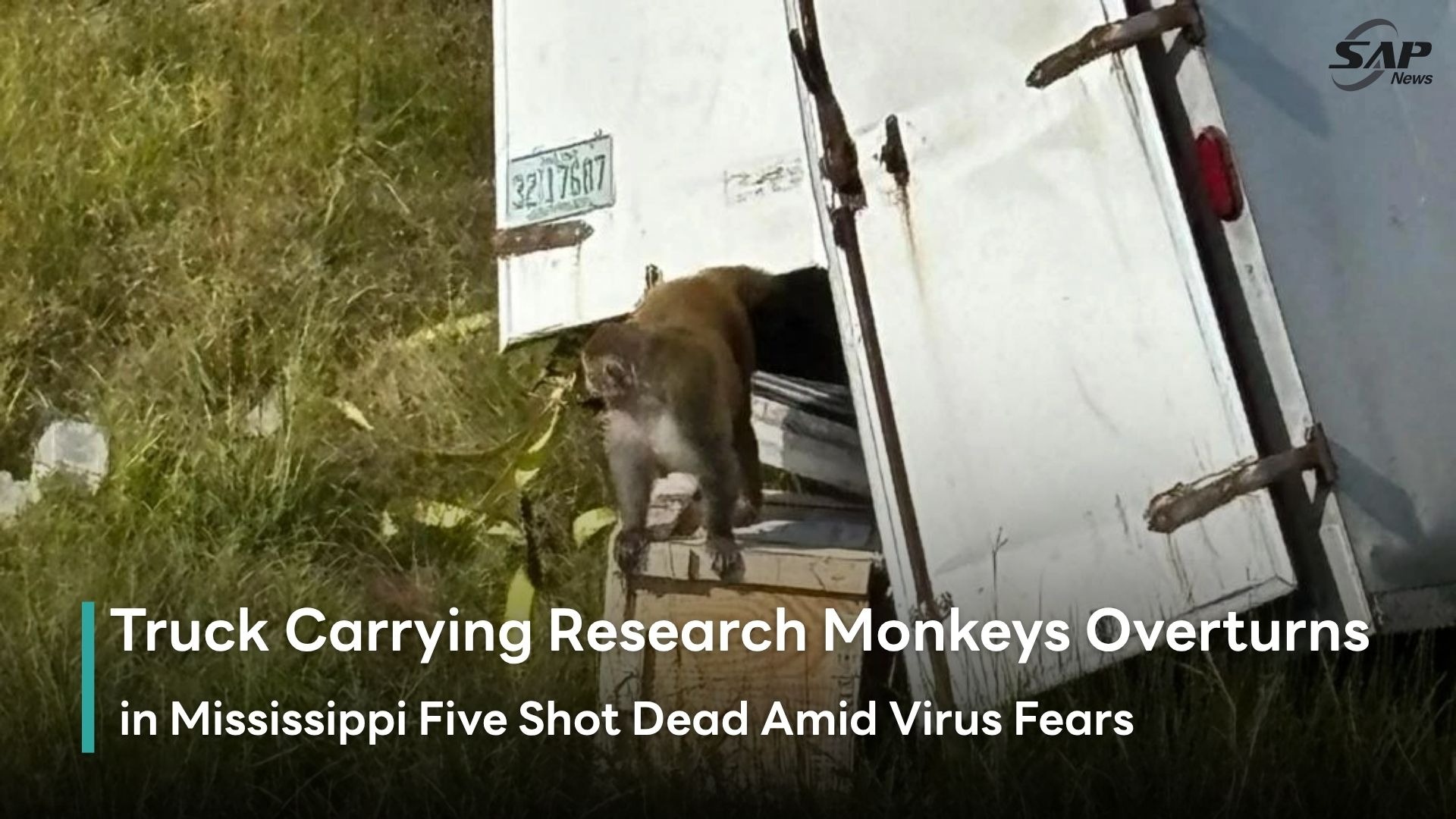
On the afternoon of Tuesday, October 28, 2025, a truck transporting rhesus monkeys overturned on U.S. Highway 59 near Heidelberg, in Jasper County, Mississippi, about 160 kilometers from Jackson, the state capital. The accident caused several crates labeled “Live Animals” to scatter across the road, and a number of monkeys reportedly escaped into the surrounding area.
Authorities have yet to determine the exact cause of the crash. Initial reports suggest that the truck may have collided with another vehicle. The monkeys were reportedly being transported from the Tulane National Primate Research Center, part of Tulane University in New Orleans, a key supplier of primates for scientific research in the United States.
However, Tulane University issued a formal statement denying any involvement, stating that the monkeys did not belong to the university and were being transported by another agency to a facility unassociated with Tulane. Unofficial reports suggest the shipment’s destination might have been in Florida or Connecticut.
Monkeys Amid Virus Concerns
Following the incident, local authorities warned residents to stay away from any escaped monkeys, citing information from the truck driver that the animals could be aggressive and potential carriers of infectious diseases, such as Hepatitis C, Herpes, and COVID-19.
Search teams were deployed with full protective equipment (PPE) to minimize risks during the recovery operation. Tulane University, however, strongly denied that the monkeys were infected, insisting they had “never been exposed to any pathogens.”
Five Monkeys Shot Dead — PETA Condemns Response
According to the Jasper County Sheriff’s Office, the truck was carrying a total of 21 monkeys. After the crash, several escaped, and officers shot and killed five monkeys out of caution, after being informed by the driver that they might carry transmissible viruses.
Subsequent inspections confirmed that three monkeys remained unaccounted for, prompting the mobilization of additional teams from the Mississippi Department of Wildlife, Fisheries, and Parks, alongside Tulane University representatives, to locate and secure the remaining animals.
Meanwhile, the animal rights organization PETA publicly criticized the decision to shoot the monkeys, calling it a reflection of the “inhumane nature of the animal testing industry.” The group demanded that necropsies be conducted on the five killed monkeys to confirm that no viral or experimental infections were present, as authorities had claimed.
Although Tulane University reaffirmed that the monkeys were not infected and not linked to its research program, uncertainty about the shipment’s origin and ownership has fueled public concern. The incident has reignited debate over the transparency and ethics of the U.S. animal research industry, which has faced growing scrutiny from both the public and advocacy groups.
Current Situation
At present, state and local authorities continue their search for the remaining escaped monkeys while conducting a thorough investigation into the cause of the crash and the conditions of the surviving animals still in transport cages.
Environmental and public health agencies have joined efforts to assess potential risks to nearby communities. Despite containment measures and drone-assisted searches using thermal imaging, officials have not yet located the three missing monkeys. Search operations remain ongoing in the wooded areas surrounding the crash site, with checkpoints established to monitor the situation closely.
Copywriter: Siam Associated Press (SAP) Editorial Department
Pictures: Some illustrations come from the Internet. If there is any infringement, please contact us to delete it.
Source of material: official media /online news
Copywriter: Siam Associated Press (SAP) Editorial Department
Pictures: Some illustrations come from the Internet. If there is any infringement, please contact us to delete it.
Source of material: official media /online news
273/3 Ratchadaphisek Rd., Ratchadaphisek, Din Daeng, Bangkok, 10400
Email reporter@sapnewsth.com
Tel. 099 569 5964