



Trump Orders U.S. to Resume Nuclear Weapons Testing for the First Time in 33 Years Amid Global Opposition, Raising Fears of a New Arms Race
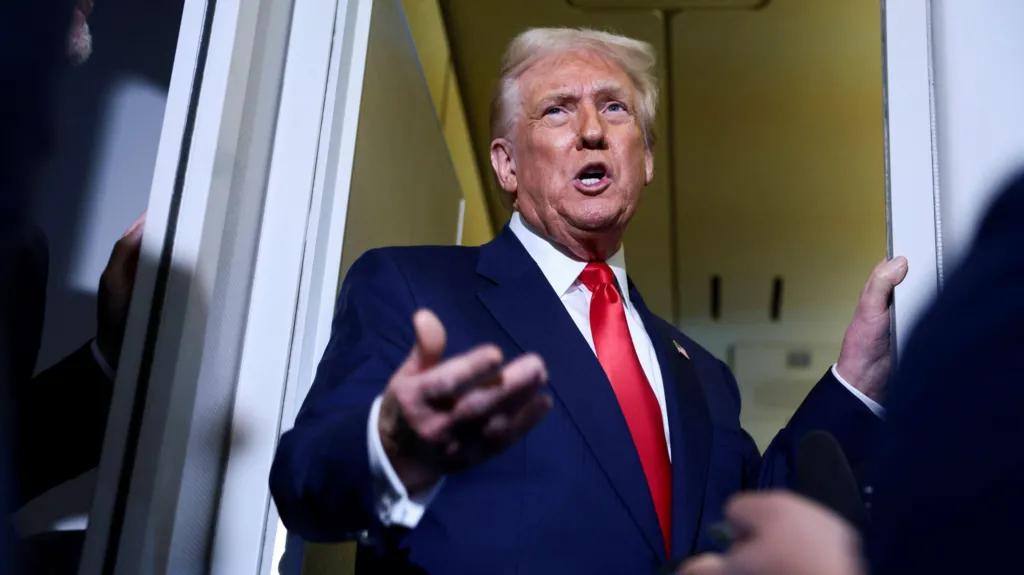
Photo: Reuters
On October 30, 2025, U.S. President Donald Trump orders the military to resume nuclear weapons testing for the first time in more than 33 years, announcing the decision in a post on his social media platform Truth Social at 9:04 p.m. Eastern Time on Wednesday.
The directive marks the biggest shift in U.S. nuclear weapons policy since 1992, sending shockwaves through Washington and the international community.
Trump’s Justification: “America must not fall behind”
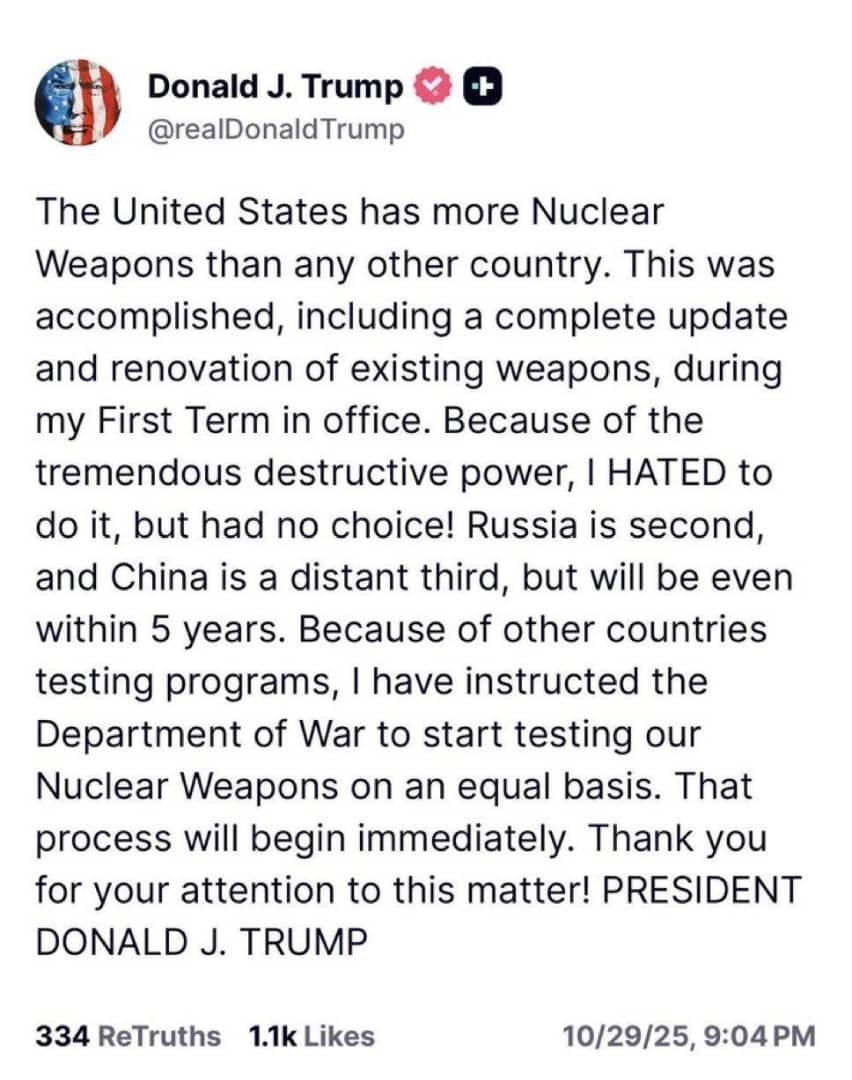
In his post, Trump wrote, “Since other countries are advancing their testing programs, I have directed the Department of War to begin testing our nuclear weapons at a comparable level. The process will begin immediately.”
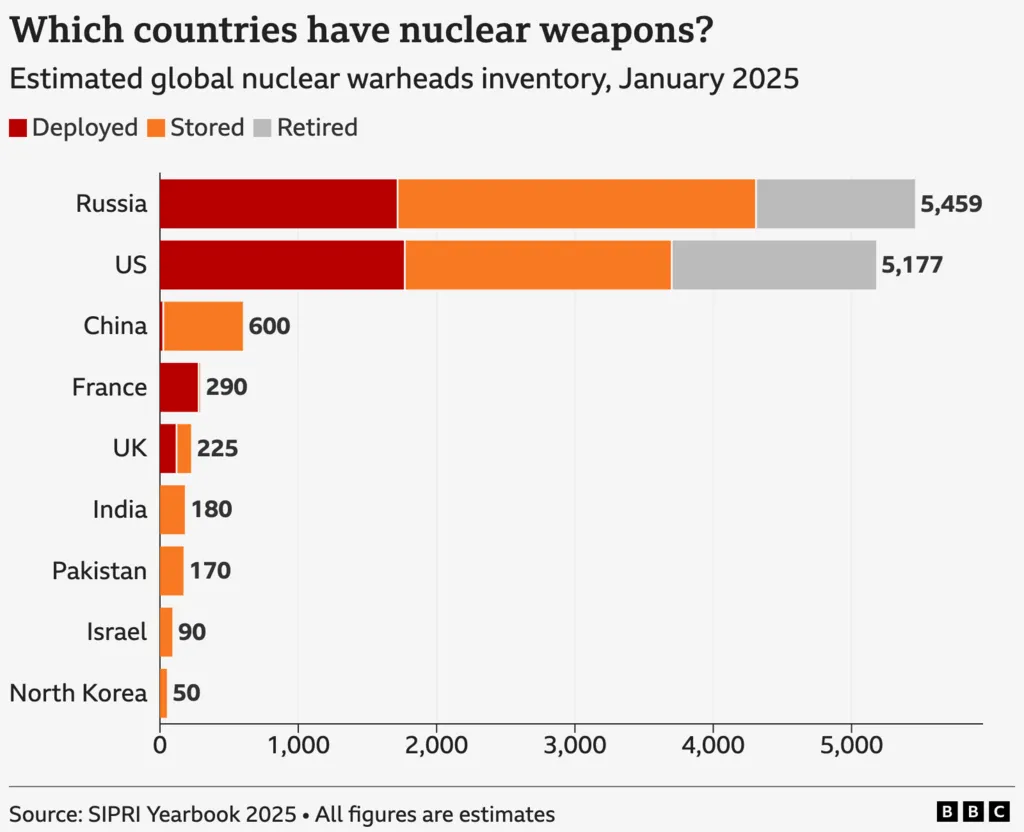
He also claimed that the United States holds the world’s largest nuclear arsenal, though data from the Stockholm International Peace Research Institute (SIPRI) and the Arms Control Association show that Russia possesses more warheads. Trump warned that China, currently estimated to have around 600 warheads, could “catch up to the U.S. within 4-5 years.”
While returning from the APEC Summit in Busan, South Korea, Trump told reporters aboard Air Force One, “If other nations are testing nuclear weapons, I think it’s appropriate that we do as well.” He added that the test site will be determined later.
At this point, it remains unclear whether Trump’s order refers to actual nuclear explosive testing, which the U.S. last conducted in 1992, or non-nuclear testing of delivery systems. Since 1990, North Korea has been the only country to carry out real nuclear tests, with its most recent in 2017.
Capitol Hill Reaction: Democrats Condemn, Republicans Back
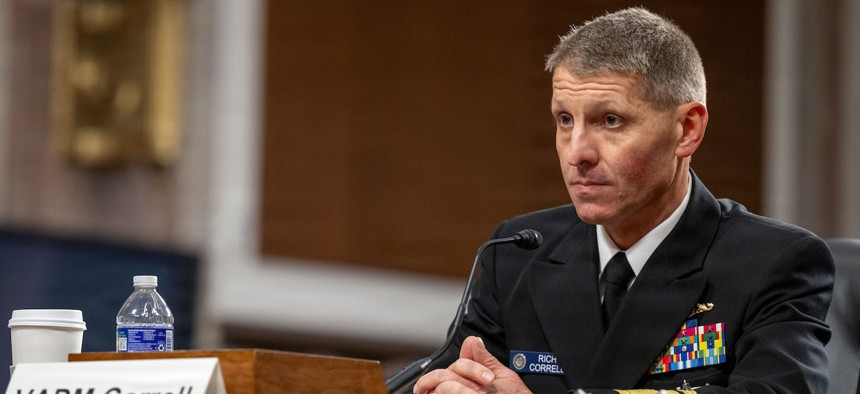
Vice Adm. Richard Correll testifies at his confirmation hearing to become the commander of U.S. Strategic Command, Oct. 30, 2025. U.S. Navy / Petty Officer 1st Class Eric Brann
On October 31, 2025, a day after Trump’s announcement, Vice Admiral Richard Correll, Deputy Commander of U.S. Strategic Command (STRATCOM), faced a Senate confirmation hearing for his promotion to Commander. Correll said his role would be to provide “data-informed military advice” to support policy decisions.
Democratic lawmakers strongly criticized the order:
Sen. Jack Reed (D-R.I.) called it “confusing and misguided,” emphasizing that the nuclear program is managed by the National Nuclear Security Administration (NNSA) under the Department of Energy, not the Pentagon.
Sen. Mazie Hirono (D-Hawaii) warned that real nuclear testing could “encourage other nations to follow suit,” noting that the U.S. already uses supercomputer simulations to ensure weapon reliability without detonations.
Sen. Jacky Rosen (D-Nev.) reminded that Nevada still suffers lingering effects from past tests, vowing to “do everything possible to prevent it from happening again.”
Republicans, meanwhile, voiced support: Sen. Tom Cotton (R-Ark.) argued that testing would “send a clear message of deterrence” to adversaries.
Vice President J.D. Vance said testing is “necessary to ensure our nuclear arsenal functions properly.”
In response, Sen. Edward Markey (D-Mass.) introduced a bill to block funding for nuclear tests, calling Trump’s order “reckless and destabilizing,” warning it could trigger a new arms race.
Global Reactions: Fears of a ‘New Cold War’
Russia: Kremlin spokesman Dmitry Peskov said Russia was “unaware of any nation currently conducting tests,” but reiterated President Vladimir Putin’s position that Moscow would “respond appropriately” if another country resumed testing. Earlier in October, Russia tested its Burevestnik nuclear-powered cruise missile and Poseidon nuclear torpedo.
China: The Chinese Foreign Ministry urged the U.S. to honor its obligations under the Comprehensive Nuclear-Test-Ban Treaty (CTBT) and avoid escalating tensions.
Iran: Foreign Minister Abbas Araghchi condemned Trump’s decision as “regressive and irresponsible,” calling the U.S. a “nuclear-armed bully” that tests weapons while accusing others of proliferation.
United Nations: A U.N. deputy spokesperson warned that global nuclear risk is already “dangerously high,” urging all countries to refrain from actions that could lead to “catastrophic consequences.”
Experts Warn: “A Historic Strategic Mistake”
Daryl Kimball, Executive Director of the Arms Control Association, stated, “If the U.S. resumes nuclear testing, it will be a historic strategic mistake that directly undermines global stability.”
He estimated that reactivating the Nevada underground test site could take at least 36 months, and stressed there is no technical need for real detonations given today’s highly accurate simulation technologies.
Analysts broadly agree that the world stands at a dangerous crossroads, if not yet in a full-scale nuclear arms race, then certainly at its starting line.
Sources: AI Jazeera, BBC, Reuters, Defenseone
Copywriter: Siam Associated Press (SAP) Editorial Department
Pictures: Some illustrations come from the Internet. If there is any infringement, please contact us to delete it.
Source of material: official media /online news
Copywriter: Siam Associated Press (SAP) Editorial Department
Pictures: Some illustrations come from the Internet. If there is any infringement, please contact us to delete it.
Source of material: official media /online news
273/3 Ratchadaphisek Rd., Ratchadaphisek, Din Daeng, Bangkok, 10400
Email reporter@sapnewsth.com
Tel. 099 569 5964