



Trump Calls Japan's PM Takaichi Still Silent on China-Taiwan Crisis, Raising Questions on U.S. Stance
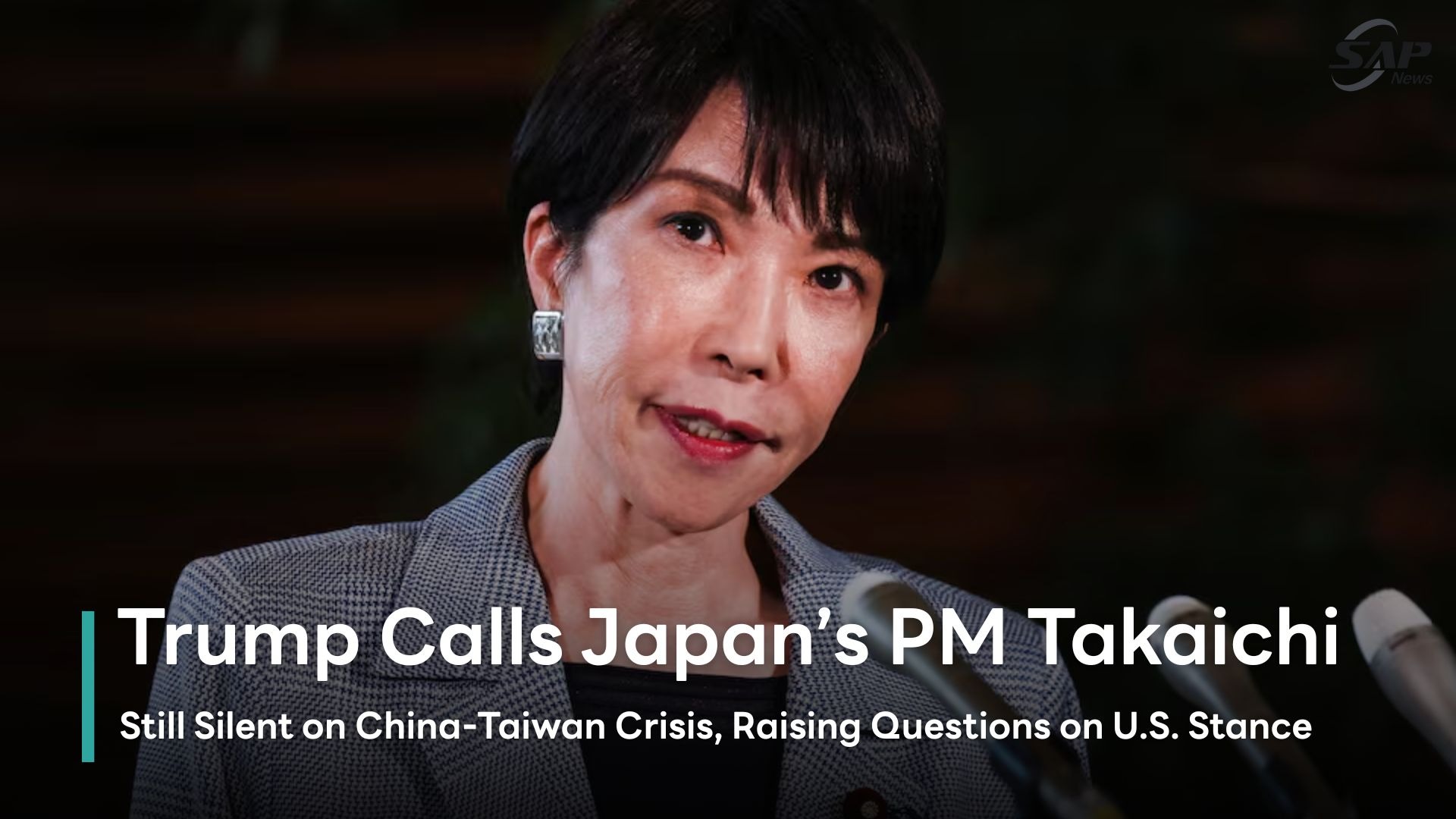
Japan's Prime Minister Sanae Takaichi speaks to the media after a telephone call with U.S. President Donald Trump, at her official residence in Tokyo, Japan, November 25, 2025. REUTERS/Issei Kato
On 25 November 2025, tensions in East Asia escalated sharply after Japanese Prime Minister Sanae Takaichi made an unscripted remark in parliament earlier this month, stating that Japan might take military action if China were to attack Taiwan under a hypothetical scenario. The comment prompted Beijing to immediately retaliate with travel restrictions targeting Japan.
China, which claims sovereignty over Taiwan and has not ruled out the use of force to bring the island under its control, responded fiercely to Japan’s position. Beijing also criticized Tokyo’s plan to deploy medium-range surface-to-air missiles on Yonaguni Island, located less than 100 kilometers from Taiwan, calling the move a provocation that heightens regional tensions. Despite pressure from Beijing to walk back her statement, Takaichi has refused to retract it, while Tokyo maintains it is open to dialogue to ease diplomatic friction.
Taiwan strongly rejected China’s claims, with Prime Minister Cho Jung-tai stressing that only the Taiwanese people can decide their future and that “reunification with China” is not an option for the island’s 23 million residents.
As tensions between Tokyo and Beijing continued to rise, China also declined a potential meeting between the two leaders on the sidelines of the G20 summit last weekend. Analysts say the development could signal the beginning of a “diplomatic winter” under Takaichi’s administration, which has been bolstered in recent years by U.S. support for Japan’s expanded military capabilities.
Amid the mounting uncertainty, Prime Minister Takaichi held a phone call today with U.S. President Donald Trump, just one day after Trump spoke with Chinese President Xi Jinping. Takaichi said Trump told her she could “call anytime” and described her as a “very good friend,” an attempt to counter fears that Trump may not fully back Japan in this dispute.
However, what is troubling officials in Tokyo is Trump’s silence on the Japan-China conflict. Following his call with Xi, Trump posted on Truth Social praising progress in U.S.-China trade discussions and the “powerful” state of bilateral relations, without mentioning Taiwan at all. The omission has raised concerns among experts that Trump may be willing to scale back U.S. support for Taiwan in exchange for a trade deal with Beijing.
Professor Seiko Mimaki of Doshisha University noted that Trump could sacrifice the Taiwan issue for economic gain. Some Japanese officials fear such a move may embolden China and increase the risk of conflict in East Asia.
While the U.S. president has yet to express a clear stance, George Glass, the U.S. ambassador to Japan, reaffirmed Washington’s support for Tokyo in confronting China’s “coercion.” Meanwhile, Japan’s Chief Cabinet Secretary Minoru Kihara emphasized that a stable U.S.-China relationship remains crucial for the international community, including Japan.
Copywriter: Siam Associated Press (SAP) Editorial Department
Pictures: Some illustrations come from the Internet. If there is any infringement, please contact us to delete it.
Source of material: official media /online news
Copywriter: Siam Associated Press (SAP) Editorial Department
Pictures: Some illustrations come from the Internet. If there is any infringement, please contact us to delete it.
Source of material: official media /online news
273/3 Ratchadaphisek Rd., Ratchadaphisek, Din Daeng, Bangkok, 10400
Email reporter@sapnewsth.com
Tel. 099 569 5964