



CMAS confirms no oil shortage; refining capacity increased by 9%, accelerating nationwide distribution
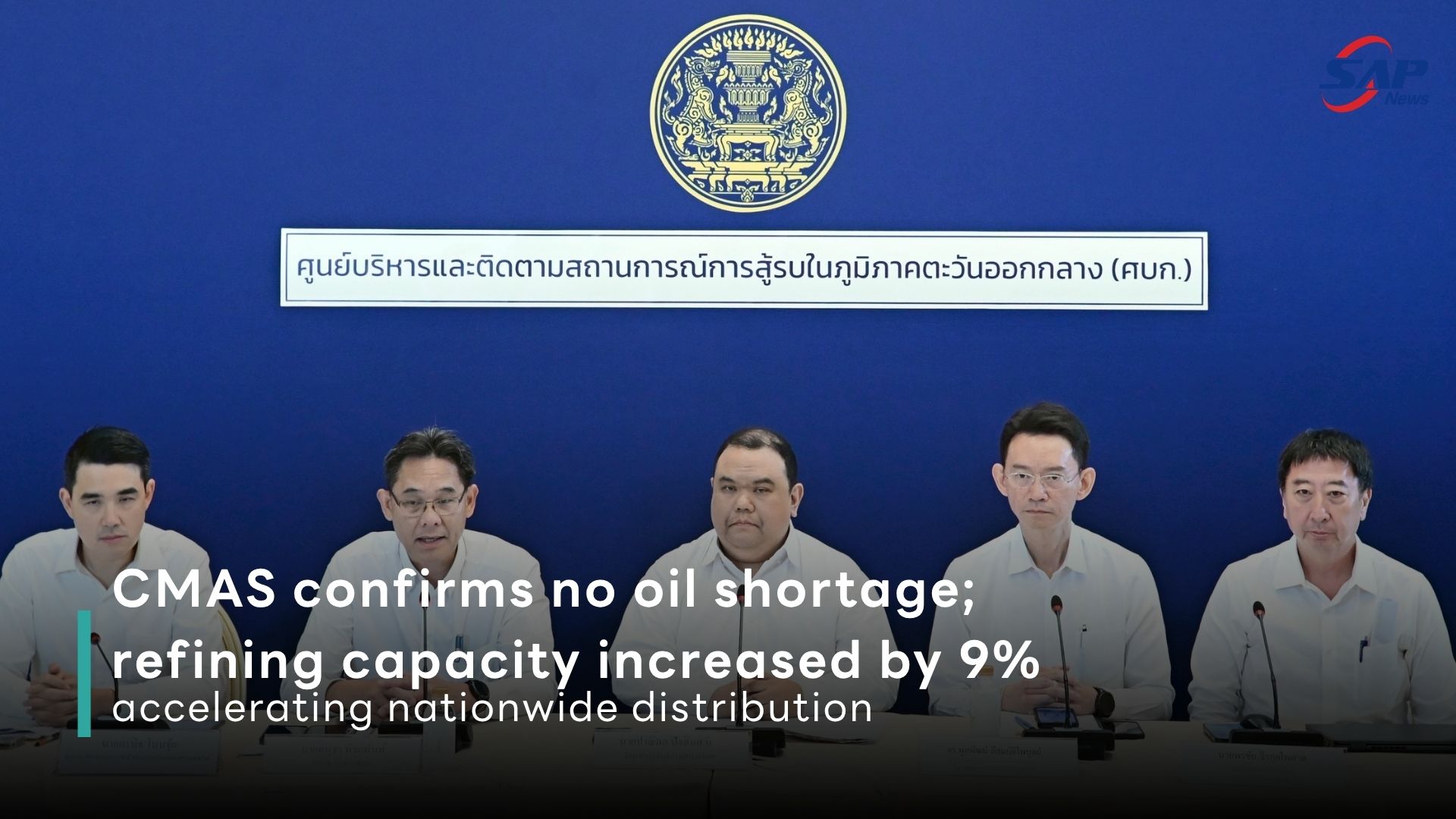
Today (24 March) at 11:05 AM, at the Center for Monitoring and Managing the Conflict in the Middle East (CMAS), Phakdi Bodin Building, Government House, Mr. Danucha Pichayanant, secretary-general of the National Economic and Social Development Council (NESDC), briefed on the progress of fuel management, following yesterday's meeting (23 March). He stated that they have been monitoring data from PTT and Bangchak, major players in the market, and found that PTT and Bangchak's refineries have increased their oil refining capacity by approximately 9 percent.
Mr. Danucha added that PTT has increased diesel production to meet public demand, resulting in increased overall oil sales, particularly for PTT OR, which saw an approximately 25 percent increase in sales, with diesel sales increasing by as much as 35 percent. Regarding oil distribution, the government has accelerated the delivery of oil to wholesalers or jobbers to reduce congestion at service stations due to industrial activity and maintain sufficient oil supply for the public. Currently, major refineries such as Thai Oil, GC, and IRPC, as well as Bangchak, have increased oil deliveries to jobbers following the government's relaxation of oil reserve requirements. This will allow for a wider distribution of fuel. However, it is expected to take 1-2 days for the system to return to normal.

Mr. Danucha added that a dashboard system displaying oil volume data from refineries and depots to service stations is currently being developed. It is expected to be available for public inspection today or tomorrow (25 March) to increase transparency and prevent hoarding. Regarding oversight, the Prime Minister has instructed all provinces to inspect gas stations daily, especially at the district level, in cooperation with the Department of Energy Business, to prevent hoarding and control oil supply.
Mr. Danucha also confirmed that oil exports are currently limited to Laos and Myanmar only, totaling no more than 5 million liters per day. Laos accounts for approximately 4 million liters per day, and Myanmar approximately 300,000 liters per day. Exports to Laos are based on electricity cooperation, particularly hydropower, while exports to Myanmar involve natural gas production, which is then used to generate electricity in Thailand.
Mr. Danucha concluded that the trend of natural gas prices in the global market has the potential to rise, requiring Thailand to manage its energy mix by increasing the proportion of hydropower and alternative energy sources to reduce electricity costs. However, the situation remains uncertain. Therefore, we request the cooperation of the public in conserving energy. Currently, the country's oil production capacity is approximately 175 million liters per day and can increase by no more than 10 percent.

Dr. Poolpat Leesombatpaiboon, Secretary-General of the Energy Regulatory Commission (ERC), as the ERC spokesperson, stated that the ERC plays a role in regulating energy businesses in accordance with the Energy Business Act B.E. 2550 (2007), especially regulating electricity prices to reflect true costs, while simultaneously creating a balance between electricity users and operators to ensure the country's energy system is secure, sufficient, and fairly priced. For Thailand's electricity production structure in 2025, it will still rely primarily on natural gas at 56 percent, while hydropower will account for 15 percent, divided into 12 percent imported from Laos and 3 percent domestically produced. Coal and lignite will account for 21 percent, and renewable energy will account for approximately 10 percent
Dr. Poolpat further stated that regarding natural gas sources... The supply is divided into 50% from the Gulf of Thailand, 10% imported via pipeline from Myanmar, and 40% liquefied natural gas (LNG). LNG plays a crucial role in energy security, with 70% procured through long-term contracts and 30% through the spot market to mitigate market volatility.
Dr. Poolpat added that preparations have been made to secure LNG in advance during the 3-month crisis period. There are plans to import three spot LNG shipments in March-April, with two already secured. The situation is being closely monitored. LNG reserves remain sufficient to meet national demand. He emphasized that all LNG procurement must adhere to price competition mechanisms to ensure fairness and benefit electricity users.
Dr. Poolpat also stated that the volatile global energy situation, particularly the tensions in the Middle East, has caused LNG spot prices to increase from approximately US$10 per million BTU to US$25 per million BTU, or more than 2.5 times the initial amount. However, he confirmed that this does not indicate a fuel shortage. However, it is the price impact that matters.
Dr. Poolpat reiterated that although Thailand imports some LNG from Qatar, it only accounts for about 6% of the total gas supply. Therefore, it can still be sourced from other locations, as LNG production sources are distributed across many regions, such as Australia, Malaysia, the United States, and Africa. In terms of management, the Energy Regulatory Commission (ERC), in collaboration with the Electricity Generating Authority of Thailand (EGAT) and related agencies, has adjusted fuel plans by increasing the use of coal, hydropower, and domestic gas to reduce LNG imports. In March alone, LNG imports were reduced by approximately 70% of one shipload, and domestic gas usage was increased by about 50%.
Dr. Poolpat confirmed that Thailand's electricity system remains stable and is not at risk of fuel shortages in the short term. He emphasized that the ERC will closely monitor the situation and adjust fuel procurement plans accordingly to control costs, maintain electricity system stability, and minimize the impact on the public and the economy.

Mr. Kornit Donjui, Inspector General of the Ministry of Commerce, assured that the Ministry of Commerce is well aware of the costs to the public from energy and raw materials. In the past, the Ministry of Commerce has worked with all wholesalers and retailers to maintain price controls. Because the Ministry of Commerce has Considering that there is no justifiable reason to raise prices on existing stock or products given the continued uncertainty, the Ministry of Commerce has taken proactive measures. The Minister of Commerce has instructed the Ministry to consult with all major wholesalers, retailers, modern trade operators, and manufacturers, as well as relevant trade associations such as the Thai Chamber of Commerce, the Thai Retailers Association, and the Thai Wholesalers and Retailers Association, to implement the “Thai Helps Thai” project. This project aims to collaboratively procure essential consumer goods in the form of house brands and fighting brands.
Mr. Kornit further stated that, in addition to the wholesale and retail mechanisms, there are target consumer goods essential for daily life, including rice, instant noodles, canned food, cooking oil, fish sauce, soap, shampoo, detergent, and toothpaste. He emphasized that all manufacturers, especially large ones with the capacity, should produce their own house brands as well as fighting brands—products popular with the public—to provide more choices for consumers. This project will not only provide more options for the public but also distribute essential goods throughout the country, across all 77 provinces, during these current difficult times. We will have a nationwide network of associations, involving local producers and retailers, along with modern trade outlets and convenience stores. This proactive measure will be implemented this week. The project aims to begin in April 2026, and the duration, as discussed with entrepreneurs, will be at least from April to May 2026, addressing the government's goal of stabilizing prices.
Mr. Kornit reiterated that tomorrow, the Ministry of Commerce will present a proposal to the Central Committee on Prices of Goods and Services (CCPG) to consider upgrading legal measures and increasing the number of controlled essential goods. This measure will expand the list of controlled items and adjust the control measures for essential goods. Previously, only price changes were announced; now, permission must be obtained before adjusting prices to reflect the current situation.
Mr. Kornit added that the Ministry of Commerce is preparing to organize "Blue Flag" consumer goods distribution activities for the public throughout the country for four months, from March to August 2026. These affordable goods will be distributed across the nation. For farmers, the Ministry of Commerce will launch the "Green Flag Plus" project. This aims to reduce the burden on farmers by lowering fertilizer costs during May-July 2026, the peak season for rice cultivation. Regarding commodity price oversight, yesterday a team of senior executives from the Ministry of Commerce, along with provincial commerce offices, governors, and provincial energy officials, visited provincial areas to monitor the trade situation.
Mr. Kornit further stated that the Provincial Committees on Prices of Goods and Services also inspected commodity prices in Bangkok and surrounding areas, visiting a total of 393 locations. They found price adjustments on some goods. The Ministry of Commerce has found 13 violations in 9 provinces during the past month, mostly involving the failure to display prices. The Ministry will continue to monitor commodity prices in cooperation with provincial commerce offices, governors, and relevant agencies to ensure public confidence.

Mr. Panidol Patchimsawat, Acting Director-General of the Department of Information and Deputy Spokesperson of the Ministry of Foreign Affairs, stated that the Ministry of Foreign Affairs had two matters to report: 1. The overall situation in the Middle East remains tense, with retaliatory attacks between the main conflicting parties and attacks on Gulf Arab states. However, most attacks have been contained. Late yesterday evening, Thailand time, the US president announced via social media that the US and Iran had held positive discussions on ending hostilities in the Middle East.
Mr. Panidol further stated that the US side had delayed an attack on Iran's energy infrastructure for 5 days. However, there are reports denying these discussions and that there will be an exchange of attacks in the region afterward. We will have to closely monitor the situation as the overall situation remains highly uncertain. The Ministry of Foreign Affairs therefore advises Thai citizens to consider leaving risky areas as soon as possible and to follow news recommendations from official channels, as well as to provide their address and contact number to the ambassador and consulate-general in charge
Mr. Panidol also stated the following: 2. Assistance for Thai citizens in the affected areas and other related actions: Regarding assistance in Israel, as reported yesterday, the embassy and Tel Aviv are coordinating with relevant agencies and EIL AI airline to repatriate the body of a Thai worker in Israel who died from shrapnel wounds. The body is expected to arrive in Thailand on the morning of March 26, 2026. Assistance in Iran and Turkey is also being monitored. According to the Embassy in Tehran and the Embassy in Ankara, along with the Department of Consular Affairs, four Thai shrimp farm workers were evacuated from Banda Abbas, a city on the southern coast of Iran.
Mr. Panidol reiterated that all four have safely crossed into Turkey and are scheduled to arrive back in Thailand tomorrow morning. Currently, there are seven more Thai students and one more Thai worker from the shrimp farm, totaling eight people, who will travel by land from Iran to Turkey tomorrow, as requested by the minister of foreign affairs for cooperation with other countries.
All parties involved regarding the safety of commercial shipping through the Strait of Hormuz are aware that some Thai commercial vessels have recently been able to safely exit the danger zone. The government, through the Ministry of Foreign Affairs, will continue to prioritize safe commercial shipping.
Mr. Panidol further stated that last night, the Minister of Foreign Affairs held a telephone discussion with the Minister of Foreign Affairs of Saudi Arabia, expressing gratitude for facilitating the return of Thai citizens from other regions to Thailand via Saudi Arabia. They also exchanged views on the situation in the Middle East, with both sides expressing a shared hope for a swift end to the conflict through diplomatic means and respect for the United Nations Charter. Since the outbreak in the Middle East, a total of 1,483 Thai citizens have been assisted in evacuating danger zones to Thailand or third countries. The Thai government reaffirms its commitment to assisting citizens in the Middle East affected by the fighting to evacuate safely.
A reporter asked about the duration of the oil price freeze. "Because right now, it seems like diesel is about to reach 33 baht. The reason for the price increase last night was the public's criticism, as they weren't informed beforehand and were shocked by the price rise," Mr. Pornchai said. He explained that global oil prices are highly volatile, rising from over $90 per barrel to over $200 and most recently increasing by another $4. This necessitates adjustments to fuel prices in Thailand to reflect true costs. However, the Fuel Fund continues to play a role in maintaining appropriate domestic retail prices.

Mr. Pornchai added that how long the price freeze will last depends primarily on the direction of global oil prices. If prices continue to rise, domestic prices will need to be adjusted accordingly. However, if the situation stabilizes and the fund has the capacity to manage the situation, an immediate price adjustment may not be necessary, especially for diesel, which requires close monitoring.
When asked about the clarity regarding the diesel price ceiling, which the government says is frozen at 33 baht, Mr. Pornchai stated that diesel prices are currently nearing that level. However, whether the ceiling will be increased cannot be determined at this time, as it depends on the global market situation. He cited past events during the Russia-Ukraine crisis as an example. The price ceiling was previously raised to approximately 35 baht per liter before the assistance measures were gradually reduced as the situation improved.
When asked further about potential economic scenarios regarding what price ceiling should be set, Mr. Pornchai stated that the Fuel Fund Office continuously prepares scenarios, assessing daily oil price fluctuations and the fund's liquidity to determine the extent to which it can intervene and stabilize prices. These scenarios are then presented to the Fuel Fund Management Committee for daily review, with figures reported every morning to aid in deciding whether to continue assistance measures.
Mr. Danucha Pichayanant, Secretary-General of the National Economic and Social Development Council (NESDC), added that oil price decisions must primarily consider the global market, which is currently highly volatile. The price of refined oil in the Singapore market has risen to over $200 per barrel, higher than the $135 per barrel during the Russia-Ukraine crisis, reflecting the energy pressures faced by many countries and their similar management approaches.
Mr. Danucha stated that the Fuel Fund has the capacity to manage prices to a certain extent but requested public cooperation in conserving energy, especially fuel, as the current situation is abnormal and likely to persist for some time. Even though conflicts in some areas have eased, oil prices may not fall rapidly because energy infrastructure in many countries has been affected and will take time to recover, while demand for oil remains strong.

When asked about a clear economic scenario ceiling for the Oil Fund and its capacity, Mr. Pornchai stated that the fund can currently support prices to a certain extent, as indicated by the Secretary-General of the National Economic and Social Development Council (NESDC). However, a specific ceiling figure cannot yet be determined, as it depends primarily on the direction of global oil prices. He acknowledged that additional borrowing may be necessary in the future, and the Fuel Oil Fund has prepared to some extent to address the situation and assist the public.
Mr. Danucha added that borrowing is still in the preparation stage, as it is government debt. Therefore, it must wait for the new government to fully assume administration and go through the relevant processes. The role of the Fuel Oil Fund is to stabilize prices to reduce volatility in domestic energy prices and prevent excessive impact on the public. However, the extent of its capacity to manage the situation needs to be assessed based on several factors.
Mr. Danucha further stated that many countries have begun reducing energy subsidies, such as Malaysia, where oil prices are higher than Thailand's for the first time in many years, reflecting the limitations of subsidy policies. Regarding future strategies, further details will be discussed. Many countries are adopting energy conservation measures coupled with targeted assistance. Thailand is currently considering such an approach, and more clarity is expected after the new government fully takes office.
When asked further about the fuel situation at gas stations in Bangkok It was found that some gas stations, especially in the Phra Khanong area, displayed signs indicating a shortage of diesel, and a number of people were unable to refuel. Furthermore, some gas stations stated they were unaware of the reason for the lack of fuel delivery, despite overall assurances that fuel supplies were sufficient. This raised questions about why shortages were still occurring in some areas. Mr. Anucha stated that over the past 20 days, Thailand imported approximately 3.4 billion liters of crude oil, which is considered sufficient for refining into finished petroleum products for domestic use, especially diesel, with refining capacity increased by approximately 9%. However, the problem is not due to an insufficient fuel supply but rather limitations in transportation. The number of transport trucks for each operator is limited and cannot be increased in the short term. Additionally, fuel transportation must adhere to stringent safety standards.
Mr. Pornchai added that although transport trucks are currently allowed to operate 24 hours a day, the transportation system is still adjusting to expedite the distribution of fuel to gas stations as widely as possible. This may cause temporary shortages in some areas. In the past, some fuel retailers prioritized refueling at their own gas stations, resulting in reduced distribution to other stations and exacerbating the shortage at existing gas stations. While gas stations themselves have limitations in terms of fuel tank capacity for each type of fuel,
Mr. Anucha reiterated that this situation has continued for almost two weeks and is expected to gradually improve as the transportation system returns to normal. He also requested the public to remain calm and conserve energy to reduce pressure on the system and help improve the situation at gas stations in the short term.
Copywriter: Siam Associated Press (SAP) Editorial Department
Pictures: Some illustrations come from the Internet. If there is any infringement, please contact us to delete it.
Source of material: official media /online news
273/3 Ratchadaphisek Rd., Ratchadaphisek, Din Daeng, Bangkok, 10400
Email reporter@sapnewsth.com
Tel. 099 569 5964