



All Eyes on the Prime Minister as He Wears Pha Mi Khit to Lead a Mobile Cabinet Meeting in Udon Thani
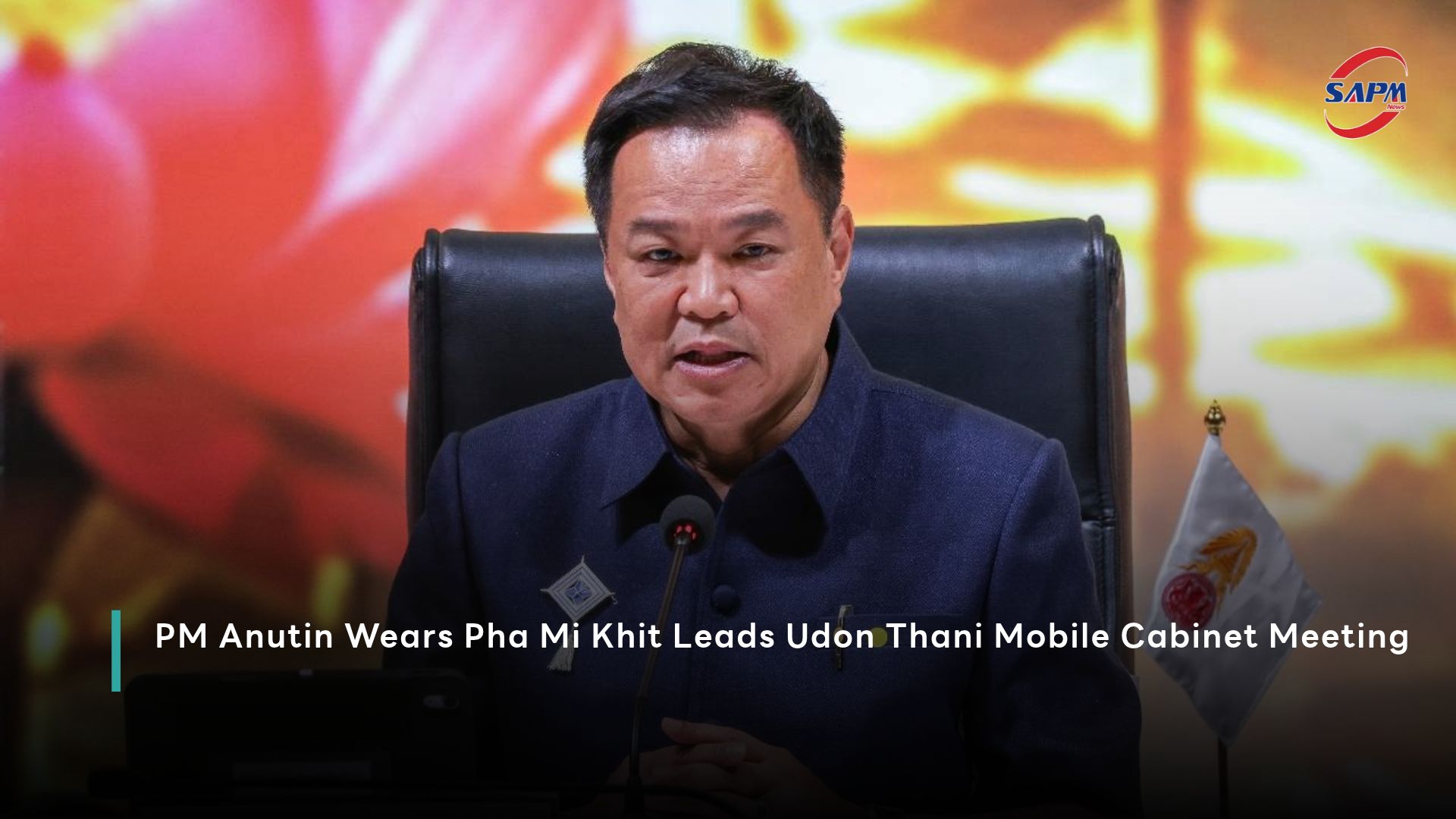
Today (3 November 2026) at 8:30 AM at the Monthathip Hall International Convention Center in Mueang Udon Thani District, Udon Thani Province, Mr. Anutin Charnvirakul, Prime Minister and Minister of Interior, accompanied by the Cabinet, presided over the second mobile Cabinet meeting of 2026. For the occasion, the Prime Minister and the Cabinet members wore garments made from pha mi khit, a traditional Udon Thani textile. The fabric, dyed a deep indigo using natural processes, features a unique luk kaew (bead-like) pattern created through a four-harness weaving technique, further embellished with pha mi khit motifs that incorporate significant local symbols of the province.
Upon his arrival, the Prime Minister visited various booths and exhibitions, including one by the Ban Chiang painted-pottery group, where he signed his name on a clay jar. He also toured the booth of the Agricultural Innovation and Art Center represented by the “Uan Klom Happy Farm” community enterprise, where he was presented with a portrait of himself, created using natural pigments on paper crafted from salvinia (water fern).

Following this, the Prime Minister posed for a group photograph with the Cabinet members. Present were the provincial governors from the Upper Northeastern Cluster 1, comprising Udon Thani, Loei, Nong Khai, Nong Bua Lamphu, and Bueng Kan provinces, along with representatives from various government agencies.
At 9:00 AM, Mr. Anutin presided over the Cabinet meeting. In his opening remarks, he noted that everyone had likely seen the launch of the International Horticultural Exposition. He commended the Ministry of Agriculture and Cooperatives, Udon Thani Province, and all relevant agencies for their immense dedication, which has resulted in a truly grand and successful event. He stated that holding the Cabinet meeting in Udon Thani presented an opportunity to establish policy for the agricultural sector—a vital national agenda. As the heart of Thailand, the agricultural sector is intrinsically linked to the livelihoods of the people; therefore, the agricultural agenda must have clear goals and receive comprehensive support from the government. This includes managing commodity prices and raw materials to generate added value, as the agricultural sector serves as both a source of food and a future source of energy, while simultaneously advancing key economic crops.
“You may have seen a peculiar news report this morning—one that warrants our attention and could, in fact, help strengthen Thailand. Thailand is a world-class producer of high-quality agricultural goods, particularly food, vegetables, and fruits. While the details have yet to be verified, the report suggests that a chain of supermarkets in Europe has fallen victim to a cyberattack, which rendered their data systems inoperable—specifically, it forced the shutdown of their cold storage systems, and this caused temperatures to rise, leading to the spoilage of goods throughout the entire system—not just in a single store, but across the whole network. The damage is substantial. While this has been reported on social media and in the news, it has yet to be fully verified. I may need to ask the Ministry of Agriculture and Cooperatives to investigate whether this is true—specifically, to what extent such a system is vulnerable to hacking or cybercrime. If it is indeed vulnerable, we must take note; as a nation that exports these types of goods, we need to be extremely cautious, not only regarding the systems themselves, but also concerning payment processes. If such incidents occur, businesses and buyers who could face significant losses due to cybercrime would be compelled to declare these losses, and it is the suppliers who would ultimately suffer. This is a critical matter,” Mr. Anutin said.

Mr. Anutin added that, at the same time, this presents significant new opportunities within the food sector. Under the current government’s policy, we are emphasizing to all stakeholders our commitment to establishing Thailand as a nation with robust food security. Furthermore, I would like to inform the Cabinet that, over the past week, private-sector entities from abroad have expressed interest in making substantial investments in Thailand. Senior executives have reached out via the Thailand Board of Investment (BOI) to request a meeting with me. I welcome all such international investors; I have already met with representatives from major industrial firms, each bringing significant capital investment to Thailand. What is encouraging and what gives us confidence is that when I asked them why they chose Thailand over other locations, their primary response was that Thailand possesses a well-prepared and capable transportation and logistics infrastructure. Thailand is better prepared than other countries in the region. It possesses a legal framework that is widely accepted and meets international standards of fairness. Furthermore, Thailand has a skilled workforce, including students and graduates capable of absorbing new technologies. Investors are confident that they can transfer these technologies to the Thai workforce, enabling them to secure employment and work effectively under their guidance.
Mr. Anutin added that, unlike in the past when the focus might have been on low-cost labor or the willingness of Thai workers to put in overtime, the current conversation centers on energy stability and the availability of robust infrastructure. This infrastructure extends to the various industrial estates and locations where these companies choose to establish their production facilities. Moreover, investors have expressed appreciation for the Thai people’s aptitude for adopting and mastering new technologies. These companies intend to bring in only a small number of experts to train Thai personnel, who will then be able to take over operational roles. Every company that has entered the market has presented a long-term roadmap; rather than proposing a tentative, single-phase trial, they have outlined plans spanning five to six phases—a testament to their deep understanding of high-tech industries. This is a very positive sign, as it contributes not only to job creation but also to broader economic growth through investment across various sectors; for Thailand, this also serves to boost trade revenue—particularly through exports—thereby increasing overall value.

“However, there have been some complaints regarding the existing procedures. The core concern is that the approval process involves too many different government agencies, some of which have conflicting policies. Even when approval is eventually granted, the process takes so long that it results in a significant waste of time. Mr. Ekniti Nitithanprapas—acting on behalf of the Deputy Prime Minister and Minister of Finance—has directed the Board of Investment (BOI) to implement a ‘Thailand Fast Pass’ policy. The goal is to provide assurance to foreign investors that, provided they are fully compliant—adhering to all environmental regulations, labor laws, and business operational requirements in Thailand—the BOI will act as the primary coordinating body. The BOI will work with all relevant government agencies to ensure that the investment approval process is both convenient and efficient, facilitating a smoother experience for investors whether they are already operating in Thailand or looking to enter the country,” said Mr. Anutin.
Photo : Yanawut Samphaothong
Copywriter: Siam Associated Press (SAP) Editorial Department
Pictures: Some illustrations come from the Internet. If there is any infringement, please contact us to delete it.
Source of material: official media /online news
273/3 Ratchadaphisek Rd., Ratchadaphisek, Din Daeng, Bangkok, 10400
Email reporter@sapnewsth.com
Tel. 099 569 5964