



Lee Miller: The Fearless Photographer Who Captured the Soul of War
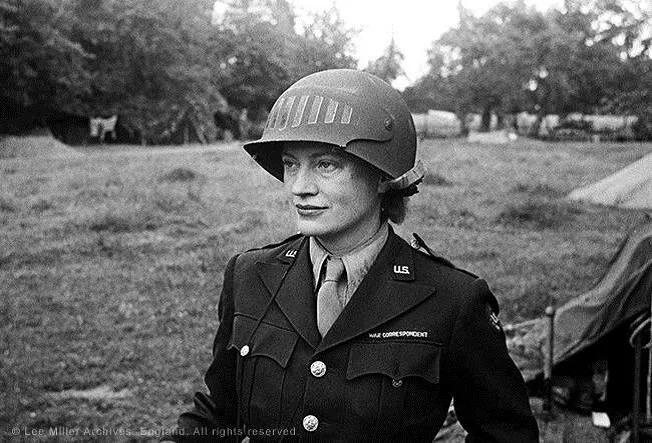
Lee Miller in a steel helmet specially designed for using a camera, Normandy, France 1944, by an unknown photographer. Photographer Unknown © The Penrose Collection, England 2015. All rights reserved.
Lee Miller was an American photographer whose surreal vision and unflinching courage made her one of the most remarkable photojournalists of the 20th century. She has been hailed by many as “one of the bravest photographers of the 20th century.” Beginning her career as a model and fashion photographer in Paris, Miller later transformed her path during World War II, becoming an officially accredited war correspondent for Vogue in 1942. Her wartime works combined fearlessness, poetic beauty, and surrealism, reflecting her belief that “being a witness is of the utmost importance.”
The Home Front
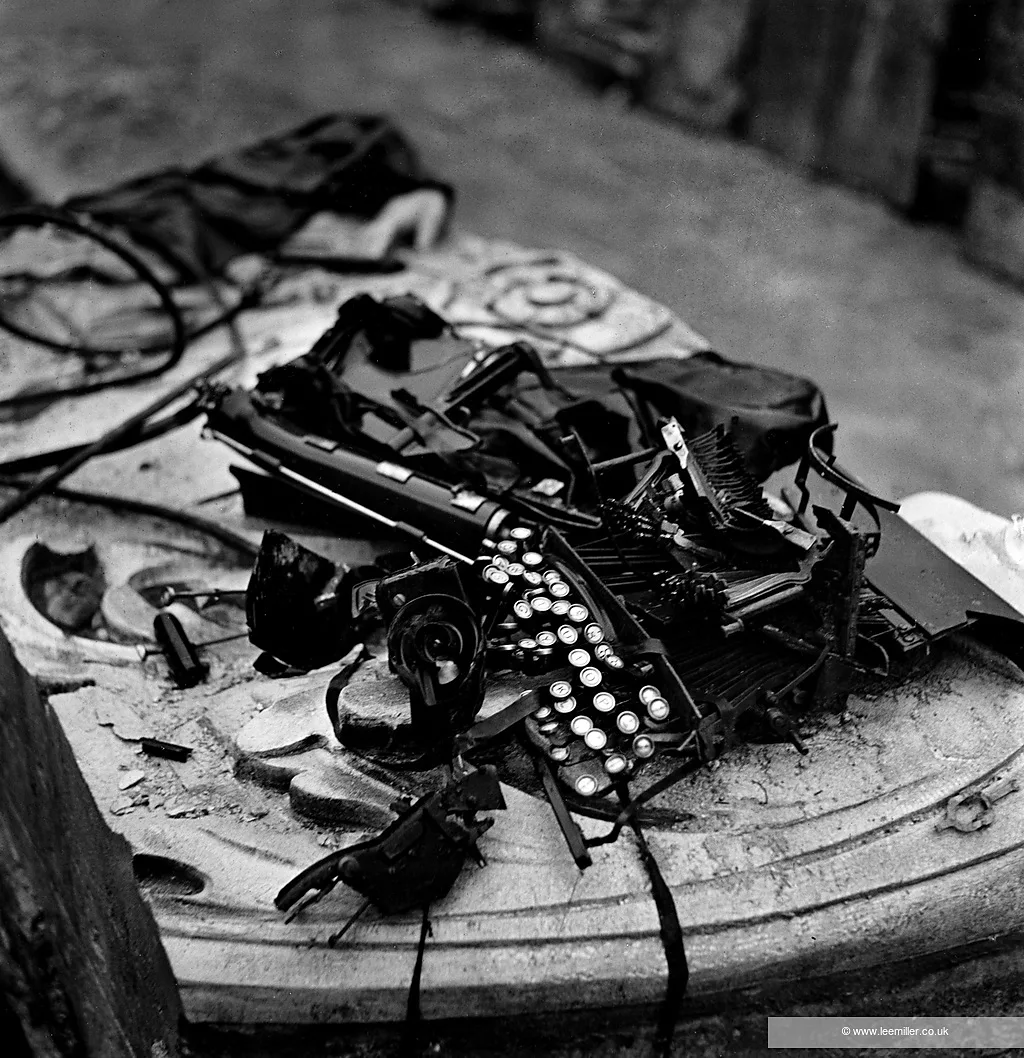
A shattered "Remington Silent" typewriter captured by Miller on a bombed building remains (1940) (Credit: Lee Miller Archives, England 2025. All rights reserved. leemiller.co.uk)
When war broke out in 1939, Miller moved to London and began working for British Vogue. Although initially rejected as a photographer, she became an essential figure after most male photographers were drafted. During the Blitz, she captured the “melancholy and absurdity” of wartime London through her sharp and surreal perspective. One of her most iconic works, a photograph of a shattered “Remington Silent” typewriter amid the rubble of a bombed building in 1940, turned the silent machine into a “powerful symbol of war’s destruction.”
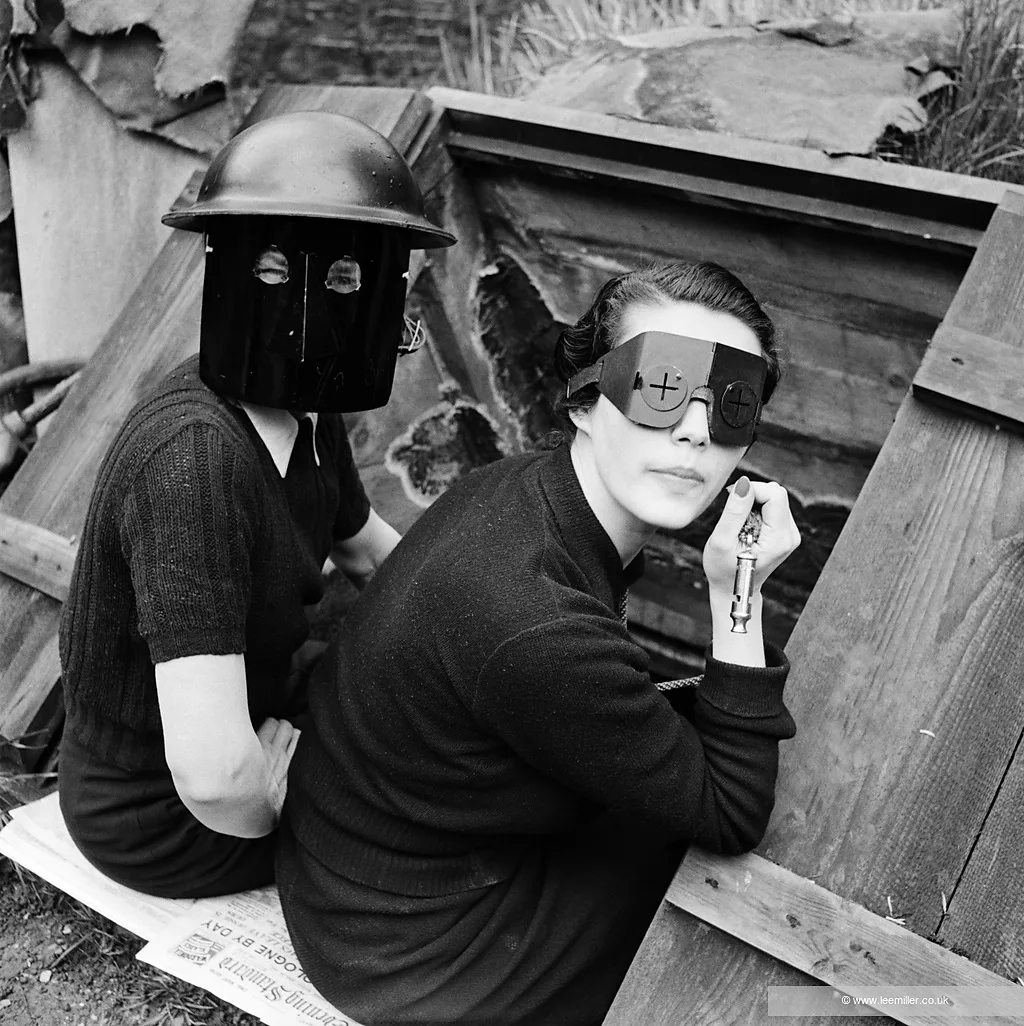
Devonshire Hill,1941, portraying Blitz-era London, has a futuristic quality by Lee Miller © Lee Miller Archives, England 2025. All rights reserved. leemiller.co.uk
Beyond her artistic pursuits, Miller collaborated with the Ministry of Information to promote public safety. Her 1941 photograph Fire Masks, featuring two women wearing fire-resistant masks in London, was praised for its “strange, futuristic chic.” Taken near the entrance of her own air-raid shelter on Downshire Hill, the image encouraged civilians to adopt protective gear designed for nighttime fire-watchers during air raids.
Women in the War Effort
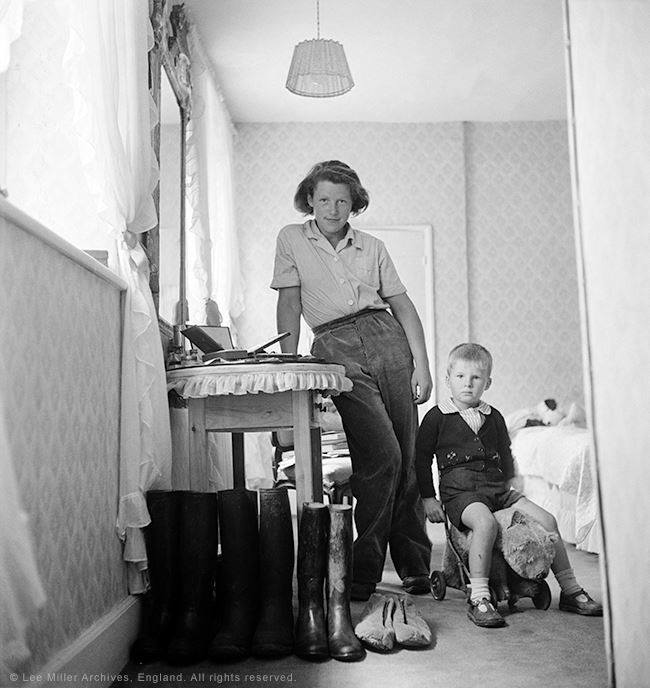
Lady Mary Dunn and young evacuee, Buckinghamshire, England 1941 by Lee Miller. © Lee Miller Archives, England 2015. All rights reserved.
As the war continued, the British government recognized the influence of women’s magazines in boosting morale and providing practical advice. Miller was commissioned by the Ministry of Information to document “the power of women in wartime.” Her photographs portrayed women in new roles, in factories, transport services, and community care. One notable image feature Lady Mary Dunn, who cared for evacuated children at her Buckinghamshire home, offering both refuge and compassion in a time of chaos.
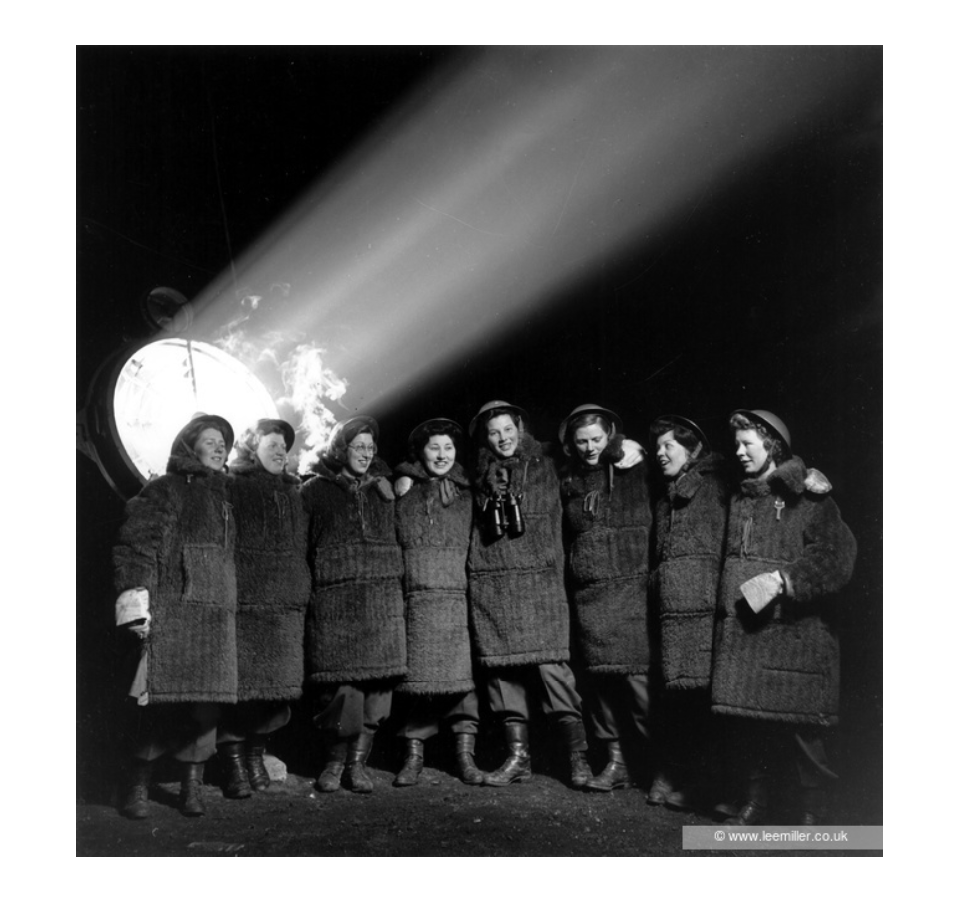
Auxiliary Territorial Service Searchlight Operators, South Mimms, North London, England 1943 by Lee Miller © Lee Miller Archives, England 2025. All rights reserved. leemiller.co.uk
Another striking series depicted female ATS searchlight operators in North London in 1943, one of the most dangerous wartime roles. These women worked under direct threat of attack, and more than 700 ATS members were killed, injured, or went missing, marking it as “the highest price paid by any women’s service.”
France After Liberation
In 1944, Miller left the home front for the battlefield. She arrived in Normandy one month after the D-Day landings, a rare achievement for a woman, since female correspondents were barred from the front lines. Due to a miscommunication, she unexpectedly found herself covering active combat during the siege of St. Malo in August 1944. Despite the danger, Miller worked courageously under fire before being briefly detained for entering the front without authorization.
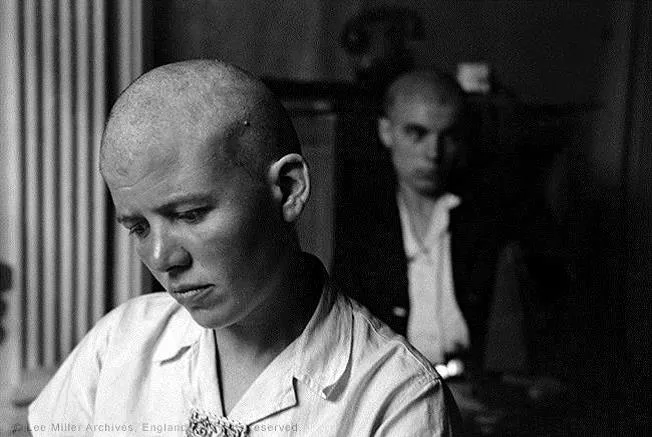
Woman accused of collaborating with the Germans, Rennes, France, 1944 by Lee Miller © Lee Miller Archives, England 2015. All rights reserved.
Later, she followed Allied forces through northwestern France, capturing both the devastation and relief of liberation. Among her most haunting images is that of a young French woman whose head had been brutally shaved as punishment for alleged collaboration with German soldiers, a public humiliation inflicted on many women accused of being “collaboratrices.” Her portrayal of these women invited reflection on justice, humanity, and the moral cost of vengeance. Exhibition curator Hilary Floe later described these images as “acts of courage and truth-telling,” breaking conventional narratives of female representation in wartime.
Into Germany and the Concentration Camps
In early 1945, Miller joined Allied troops advancing into Germany, where she witnessed the horrors of the Nazi concentration camps Buchenwald and Dachau. At Buchenwald, liberated on April 11, she arrived soon after and described how even battle-hardened soldiers “vomited and wept” at the scenes before them. On the way to Dachau, she and fellow Vogue photographer David E. Scherman encountered a “death train,”
forty boxcars filled with hundreds of corpses, an image that became one of the most haunting testaments to Nazi brutality.
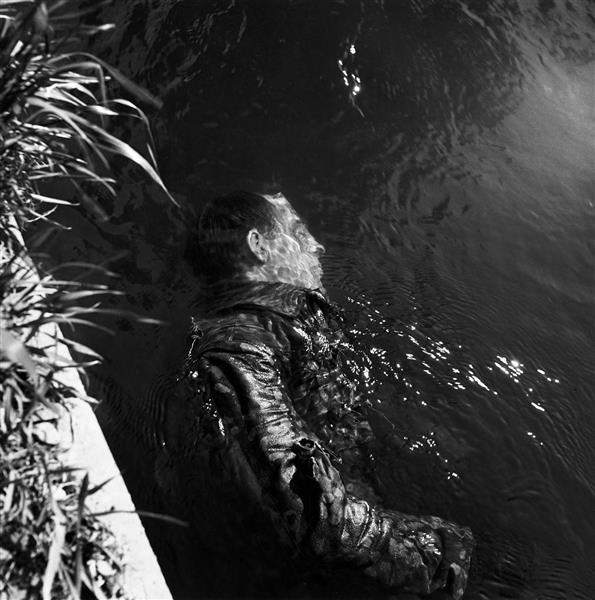
SS Guard in Canal, Dachau, Germany, 1945 by Lee Miller © Lee Miller Archives, England 2025. All rights reserved. leemiller.co.uk
On April 30, 1945, Miller was among the first photographers to enter Dachau. Her stark and powerful photographs of corpses, survivors, and surrendering SS officers are among the most enduring records of the Holocaust. The face of one captured SS man, “lit up by Miller’s flash,” became a chilling symbol of complicity and exposure. Fearing readers would doubt such horror, she telegraphed Vogue pleading, “I beg you to believe this is the truth.”
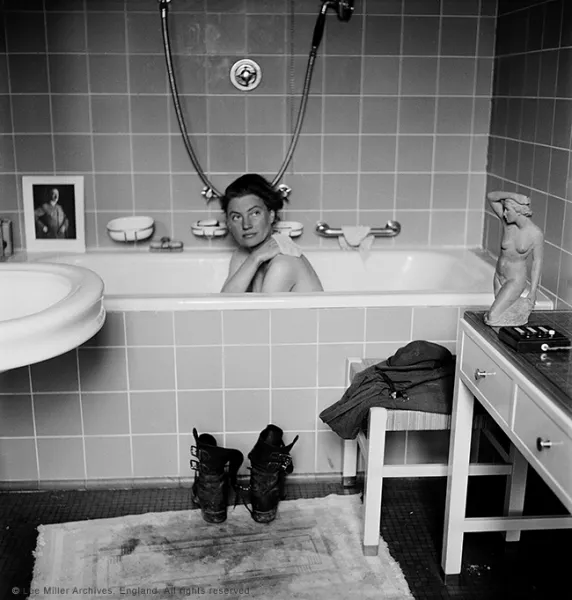
Lee Miller in Hitler's bathtub, Hitler's apartment, Munich, Germany 1945. By Lee Miller with David E. Scherman © Lee Miller Archives, England 2015. All rights reserved.
That same day, Miller and Scherman reached Hitler’s apartment in Munich. There, she famously photographed herself bathing in Hitler’s bathtub, her boots, still caked with Dachau mud,
placed defiantly on his bath mat. The image became a striking symbol of the collapse of tyranny and the reclamation of humanity after unimaginable evil.
The Burden of Bearing Witness
The atrocities Miller witnessed left her deeply scarred. The trauma of the camps haunted her for the rest of her life. Yet, what she left behind was not only documentation of war but a testament to truth, courage, and humanity amid darkness. Lee Miller did more than photograph war; she photographed the human spirit, revealing both its strength and its breaking point. Her legacy reminds us that to bear witness is itself an act of extraordinary bravery.
Source: BBC, Imperial War Museums, National World War 2 Museum, The Guardian
Copywriter: Siam Associated Press (SAP) Editorial Department
Pictures: Some illustrations come from the Internet. If there is any infringement, please contact us to delete it.
Source of material: official media /online news
Copywriter: Siam Associated Press (SAP) Editorial Department
Pictures: Some illustrations come from the Internet. If there is any infringement, please contact us to delete it.
Source of material: official media /online news
273/3 Ratchadaphisek Rd., Ratchadaphisek, Din Daeng, Bangkok, 10400
Email reporter@sapnewsth.com
Tel. 099 569 5964