



Saudi Crown Prince Visits the US to Advance Security, Nuclear, and AI Cooperation
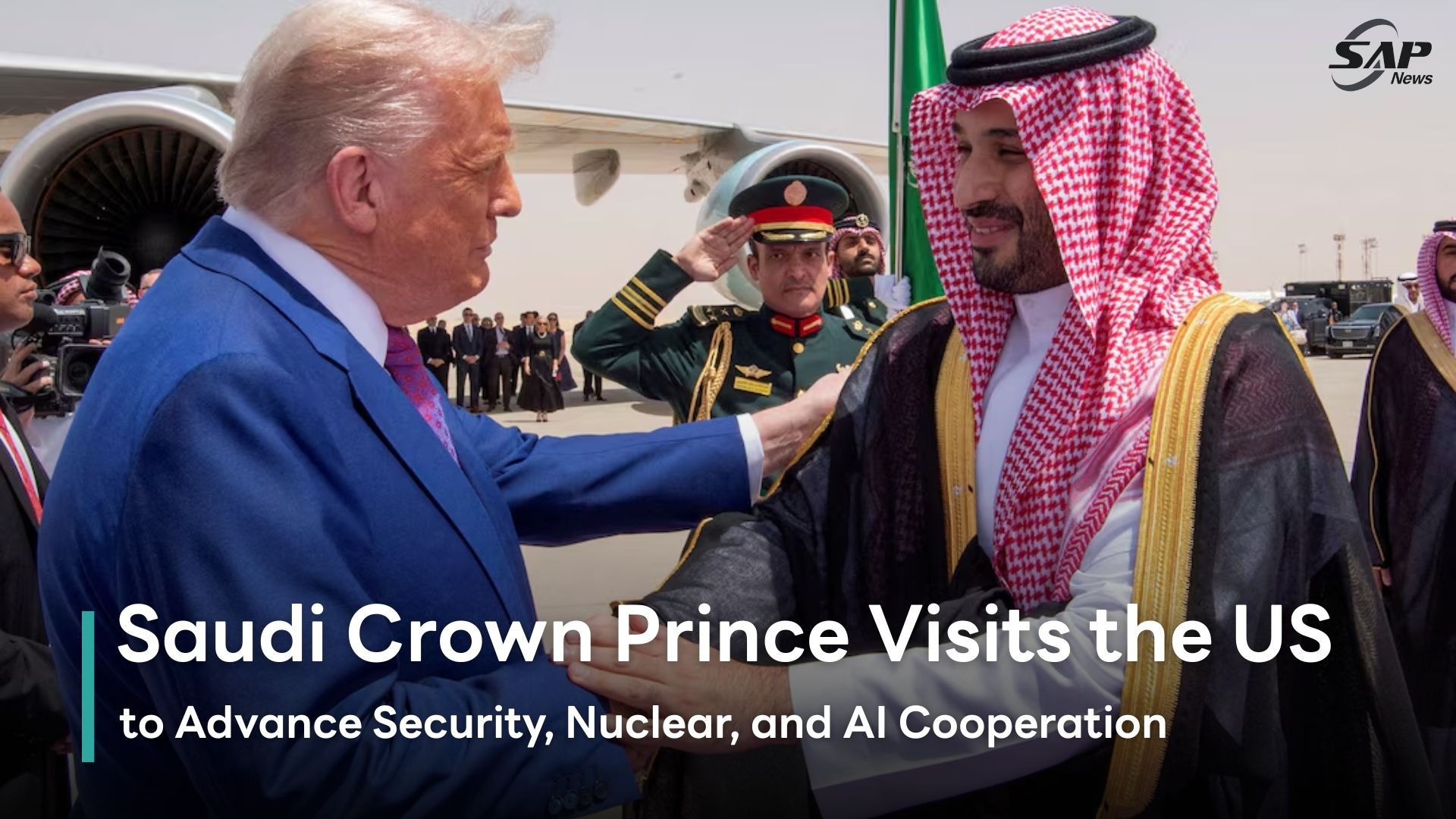
On November 17, 2025, Saudi Arabia’s Crown Prince Mohammed bin Salman (MBS), the kingdom’s de facto ruler, is set to meet U.S. President Donald Trump at the White House, aiming to reinforce decades-long security and energy ties while expanding cooperation in trade, technology, and civilian nuclear development.
Central to the Crown Prince’s agenda is securing formal U.S. security assurances amid heightened regional instability, as well as advancing artificial intelligence (AI) capabilities and pursuing progress on a civilian nuclear agreement.
Meanwhile, Trump is expected to press Riyadh to reaffirm its earlier pledge of USD 600 billion in investments in the United States. The visit marks MBS’s first trip to the U.S. since the 2018 killing of Saudi dissident Jamal Khashoggi, a case that U.S. intelligence assessed MBS had approved, though both sides appear intent on moving forward, with analysts noting that the Khashoggi matter has been largely “turned over.”
Security negotiations remain a focal point as Saudi Arabia continues to push for a congressional-backed security pact following Washington’s failure to respond decisively to the 2019 attacks on its oil facilities and Israel’s recent strike on Doha, Qatar, in September.
However, the Biden administration has tied any formal agreement to Riyadh’s normalization of relations with Israel. Saudi Arabia has responded by conditioning such normalization on a clear Israeli commitment to the establishment of a Palestinian state, a position that Prime Minister Benjamin Netanyahu firmly opposes. Analysts expect both countries may ultimately settle for a compromise similar to Trump’s earlier executive order with Qatar, requiring immediate consultations in the face of threats but stopping short of obligating U.S. involvement in offensive military action.
At the same time, Riyadh is accelerating efforts under its Vision 2030 strategy to secure advanced AI technology and expand its civilian nuclear program. Seeking to position itself as a global AI hub and compete with the United Arab Emirates (UAE), which already has access to high-end computing chips, Saudi Arabia is pushing Washington for approval to purchase advanced semiconductor chips.
MBS is also looking to finalize, or at least advance, a civilian nuclear cooperation agreement with the U.S., which would grant the kingdom access to critical nuclear technology and strengthen its regional standing vis-à-vis traditional rivals Iran and the UAE.
Yet progress on the nuclear file remains slow. Riyadh has resisted U.S. conditions prohibiting uranium enrichment and the reprocessing of spent fuel, two pathways with potential military applications. Even so, past negotiators expect that both sides may announce a framework or signal progress toward a future agreement during this visit.
Throughout the discussions, Trump has avoided raising human rights concerns, focusing instead on advancing the substance trade and investment agenda underpinning the U.S.-Saudi partnership.
Source: Reuters
Copywriter: Siam Associated Press (SAP) Editorial Department
Pictures: Some illustrations come from the Internet. If there is any infringement, please contact us to delete it.
Source of material: official media /online news
Copywriter: Siam Associated Press (SAP) Editorial Department
Pictures: Some illustrations come from the Internet. If there is any infringement, please contact us to delete it.
Source of material: official media /online news
273/3 Ratchadaphisek Rd., Ratchadaphisek, Din Daeng, Bangkok, 10400
Email reporter@sapnewsth.com
Tel. 099 569 5964